Does Chicken Manure Burn Plants? Fresh vs Composted Poultry Manure
Yes, fresh chicken manure burns plants, especially seedlings and young roots, because it is high in ammonia and salts. Well-composted manure is far gentler. The fix is not to avoid poultry manure but to let it age or compost first, spread it thinly away from stems, and work it into the soil well before planting.
Poultry manure is one of the strongest organic fertilizers you can buy, and that strength is exactly why people get burned by it. Many growers have lost a bed of seedlings to a fresh load and sworn it off. Others buy the cheapest material and spread it as it comes. This article separates the two cases, shows what published sources say about ageing times, explains how to apply manure safely, and is straight about how our own poultry products fit in.
Why fresh manure burns
Gardening and farming sources agree on two main causes:
- Ammonia. Fresh droppings contain uric acid that turns into ammonia. It scorches roots and young plants.
- Salts. Fresh manure is salty, and a high salt level around roots pulls water out of the plant instead of feeding it.
There is a third cause that catches people who think “old-looking” means safe: incomplete composting. Manure that has only partly broken down can start fermenting again once it is in the soil. The heat of that second fermentation damages roots and seedlings in the same way. So manure that merely looks dry is not necessarily ready.
Overuse is the last trap. Even well-aged manure can burn if you apply so much that the plants receive more nitrogen than they can handle.
Fresh versus composted at a glance
| Fresh | Composted and mature | |
|---|---|---|
| Ammonia and salts | High | Much lower |
| Burn risk | High; damage can show within a day or two, according to Gardening Know How | Low, unless you overapply |
| Smell | Sharp, biting | Earthy, mild |
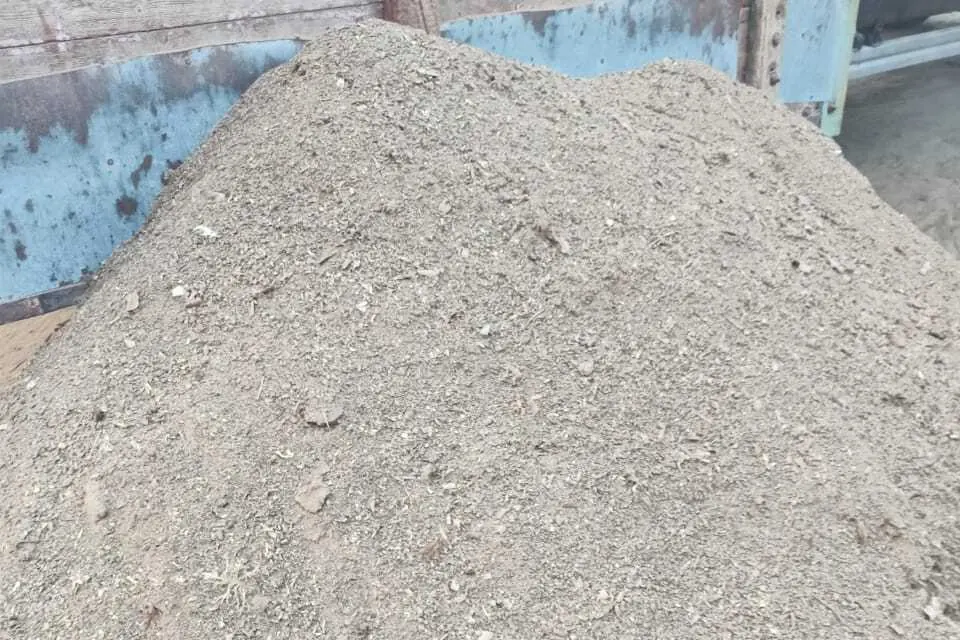
| Look | Wet, sticky or lumpy | Dark and crumbly |
| Safe use | Months before planting, away from standing crops | Before planting or as a thin top-dressing |
Health matters too. The same source (read on 13 November 2026) notes that fresh poultry manure can carry Salmonella, Campylobacter and E. coli, while stable composted manure is much less of a concern.
How long does poultry manure need?
Published figures vary, and no single number fits every pile:
- Arabic-language agricultural sources (including agro-lib.site, greenfue.com and worldofagri.com) recommend ageing from two to three months up to six months, depending on the source.
- Gardening Know How puts hot composting at roughly 6 to 10 weeks start to finish. Typical is 60 to 90 days with turning, or 3 to 6 months including curing. Cold composting, where the pile is left alone, takes 6 to 12 months.
- Under US organic rules, as summarised by the same sources, a compost pile must hold 131 to 170 F (55 to 77 C) for 3 days in an enclosed or static aerated system, or for 15 days with at least five turnings in an open windrow.
Treat these as benchmarks for a managed pile, not a recipe for any heap. A pile left in the sun for weeks without turning has not necessarily composted.
How to tell it is mature
Sources give the same signs: dark colour, crumbly texture and an earthy smell rather than a sharp one. If you open the pile and catch biting ammonia, it is not done. For a longer look at maturity checks, see how to tell when compost is mature.
How to apply it without burning anything
The sources agree on a few practical rules:
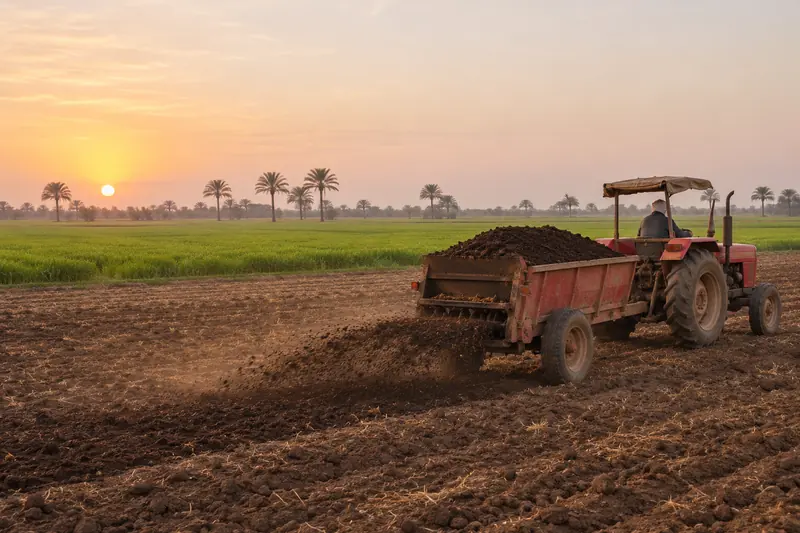
- Pick the timing. Autumn or right after harvest, or spring before planting. Leave enough time between spreading and sowing for the manure to settle in the soil.
- Thin layer. Sources quote a surface layer of about 5 to 10 cm. That is a range quoted by the Arabic-language agricultural sources above, not our recommendation; adjust by a soil test and your local agronomist’s advice.
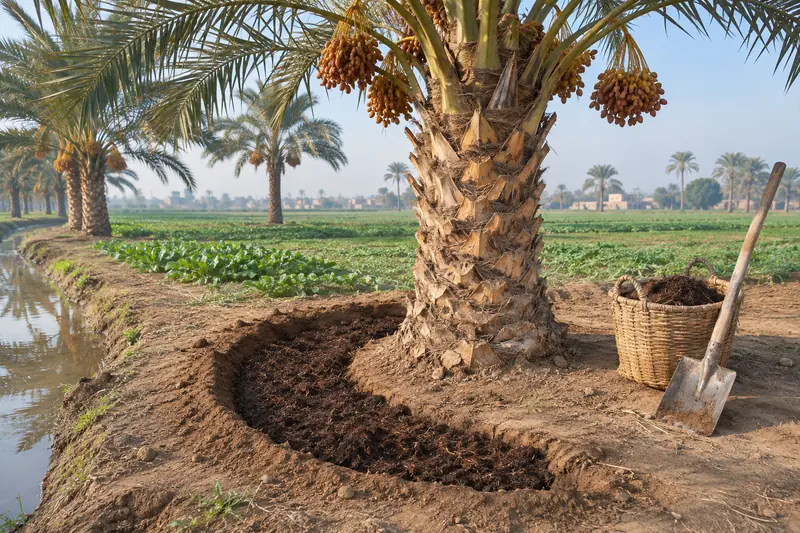
- Keep it off stems. Do not pile manure against a plant stem or tree trunk.
- Work it into the soil before planting, then irrigate.
- Do not overdo it. More manure means more nitrogen, and excess nitrogen burns plants even when the manure is composted.
For orchard trees, manure usually goes into a trench to one side rather than against the trunk. Details are in our post on fertilizing date palms.
If you plan to make compost yourself
Some buyers take fresh material and compost it on their own land. The USDA figures above give you a way to check whether your pile is being managed or merely abandoned:
- Temperature. A working pile enters the 55 to 77 C range. A cold pile is slow and can take 6 to 12 months.
- Turning. The open-windrow rule asks for at least five turnings during 15 days of high heat.
- Time. Count on 60 to 90 days with turning, then allow curing time before you test it.
Then check the pile against the maturity signs. If you still smell ammonia, wait.
If you applied fresh manure by mistake
If leaves yellow or scorch after an application, do not add more nitrogen. Stop fertilizing, irrigate well, watch the plants for a few days, and talk to your agronomist before deciding to replant. It is far easier to leave enough gap between manure and planting in the first place.
Crops that are eaten raw
Sources are firmest here. Do not put fresh poultry manure on crops eaten raw, such as leafy greens or strawberries. Where manure is only aged and not hot-composted, the US organic rule quoted by Planting Season (read on 13 November 2026) is to apply it at least 120 days before harvest for crops whose edible part touches the soil, and 90 days before harvest for other crops. If you grow strawberries, onions or garlic, see organic fertilizer for strawberries, onions and garlic.
Our poultry products, honestly
We sell four poultry products by the ton. We do not state an ageing time for any of them in this article; the sales team can tell you the condition of the batch available when you order.
- Layer poultry manure: droppings from laying hens, 1,400 EGP per ton.
- Broiler poultry litter: litter from broiler houses, 900 EGP per ton.
- Fresh belt poultry manure: fresh by its name, taken from manure belts. 750 EGP per ton. Everything in this article applies to it: it needs ageing or composting before use near any growing crop.
- Poultry mix: 750 EGP per ton.
Prices are per ton, confirmed by sales at order time. Browse the whole poultry manure range for the current list.
Which one suits you?
- You need to use it soon: ask what condition the available batch is in. Do not assume the cheapest option is ready to spread.
- You can compost it yourself: fresh belt manure is an economical raw material if you have the space, the turning and the time, and you stick to the ranges above.
- Sandy or reclaimed ground: read improving sandy and reclaimed soil before deciding on a rate.
Common mistakes
- Heaping manure against the stem “to strengthen it”.
- Adding more because the price is low.
- Spreading it on beds that already hold small seedlings.
- Judging maturity by dryness alone.
- Forgetting to irrigate after applying.
What a wheat study suggests
Reporting by Al-Watan (read on 13 November 2026) describes Dakahlia wheat studies in which compost enriched with poultry manure outperformed both EM-inoculated compost and farmyard manure. The point is that poultry manure, once it has been through composting, is a valuable input and not something to fear.
FAQ
Can I use fresh chicken manure at any time of year?
It is not advised near standing plants or seedlings. If you have no choice, apply it long before planting, mix it into the soil, and ask your agronomist about timing for your crop.
How long should I wait between applying manure and planting?
Sources differ and we do not give a figure of our own. For crops eaten raw, the US organic rule points to 90 or 120 days before harvest if the manure was not hot-composted. For other crops, follow your agronomist and a soil test.
Is fresh belt poultry manure ready to use straight away?
It is fresh by its name, so treat it as fresh manure: age or compost it before use. Ask us about the condition of the batch available when you order.
Order or ask us
Choose the product, the quantity in tons and your governorate on the order page. A WhatsApp message with a reference number opens, and the sales team confirms price, quantity and delivery date. We deliver to all Egyptian governorates from Itay El Baroud. For questions before you order, message us on WhatsApp 01012205022, browse the shop, or contact us.