How to Reclaim Salty Soil: What Gypsum and Organic Matter Each Do
Agricultural gypsum does not cure every salty field. It cures sodic soil, where too much sodium sits on the soil particles, because it supplies calcium that pushes the sodium out so water can wash it away. A soil that is only saline, with salt but no sodium problem, needs good drainage and leaching water, and gypsum does not help it, according to Oregon State University. Organic matter is a helper: it improves structure and water movement. Test the soil first to learn which kind you have.
The first mistake: calling every white crust “salinity”
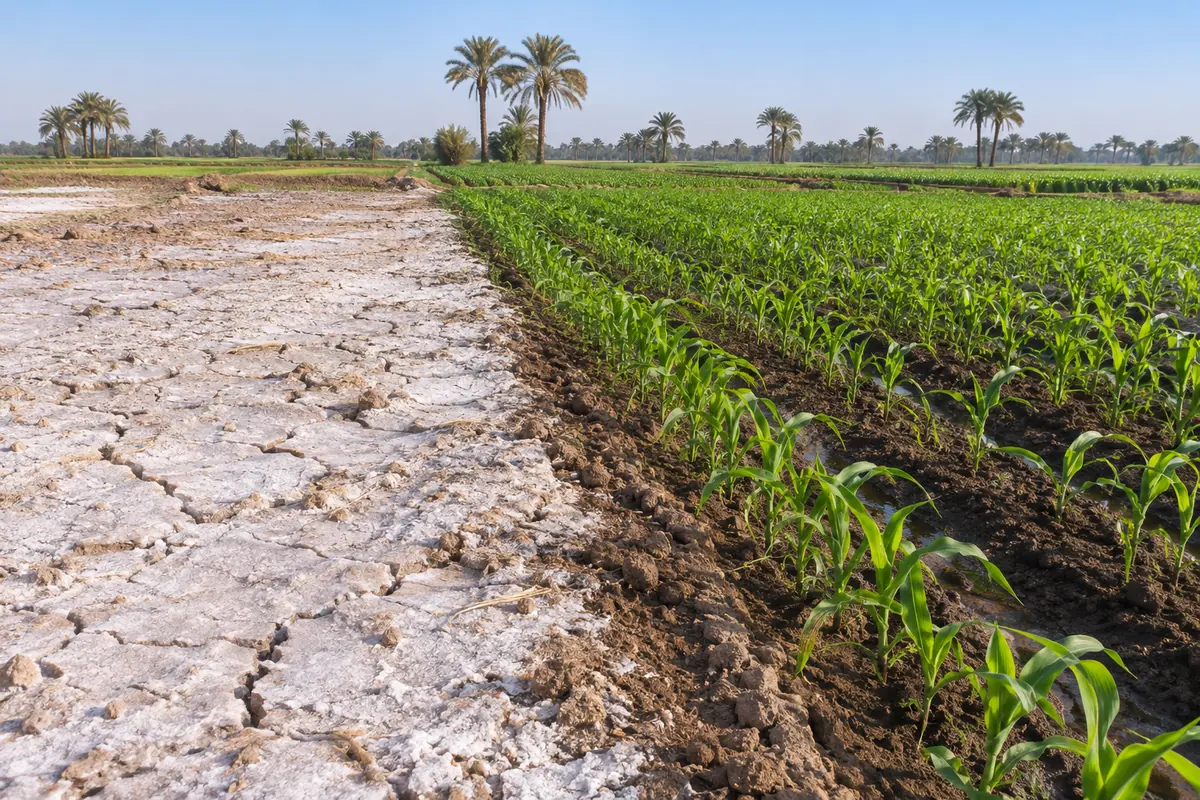
Many growers call any field with a white crust a salty field and then buy gypsum. If the field is purely saline, that money is wasted. Salt-affected land comes in three kinds, and the difference decides the treatment. We rely on two sources here: the Al-Ard newspaper article on salt-affected soils and their treatment, published 24 July 2016, and Oregon State University extension publication PNW 601, Managing Salt-Affected Soils for Crop Production.
| Type | Salinity (EC) | Exchangeable sodium (ESP) | pH | What it looks like |
|---|---|---|---|---|
| Saline | above 4 dS/m | below 15% | usually below 8.5 | White crust on top, structure still sound |
| Sodic (alkaline) | below 4 | above 15% | often above 8.5 | Dispersed soil that seals and cracks, sometimes dark |
| Saline-sodic | above 4 | above 15% | above or below 8.5 | Both salt and sodium problems |
The figures come from the Oregon State publication and broadly match the Al-Ard article, which writes salinity in mmhos/cm, a unit equal to dS/m. The pH limit printed for saline soil in the Egyptian article looks like a typing error, so we used the Oregon figure in that column.
The practical meaning is simple: test salinity, exchangeable sodium and pH in a laboratory. Those three numbers change what you should buy.
What gypsum actually does
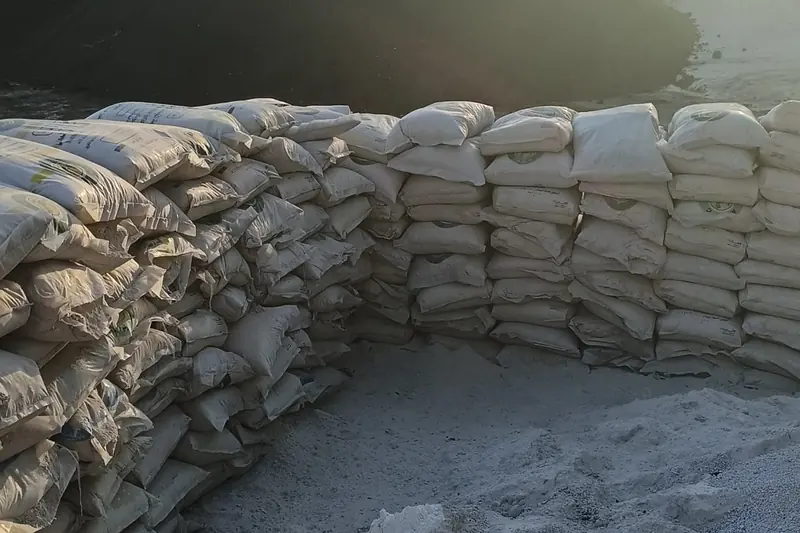
Agricultural gypsum is hydrated calcium sulphate. Oregon State explains that it supplies calcium, which replaces sodium on the surface of soil particles, lowers the exchangeable sodium, and the displaced sodium is then washed out by irrigation water through drainage. It adds that the sulphate is not likely to harm crops.
Gypsum is itself a salt, so the same publication says it does not help reclaim saline soil, since it would only add to the salt. A Kansas State University extension guide, MF1022, says the same thing in plain terms: chemical amendments cannot reclaim saline soils, which are reclaimed by applying enough good-quality water to leach out the excess salts. The Egyptian Al-Ard article states that for saline soil there is “no alternative to leaching”.
Some Arabic farm pages nevertheless give gypsum rates for salty land, and we reproduce them below. There is a reasonable explanation: many soils in the Delta and the coast are partly saline and partly sodic, so gypsum belongs in the treatment. The deciding number is the exchangeable sodium in the lab report.
On sandy soil, other sources say gypsum mostly supplies calcium and sulphur rather than driving out sodium. So know your soil before you judge what gypsum will do.
What organic matter does
Manure and compost do not remove salt or displace sodium by themselves. Their supporting role comes from two directions:
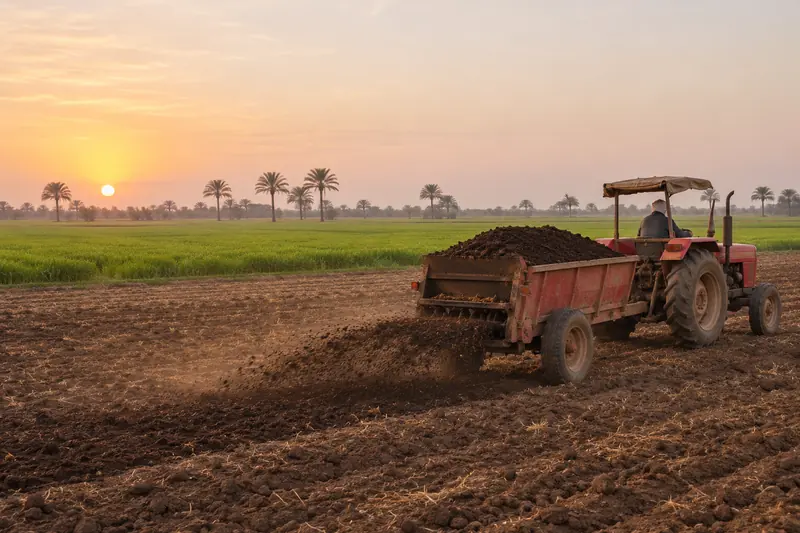
- Structure and water movement. Oregon State says coarse materials such as straw, cornstalks and sawdust can improve structure and infiltration when used together with other reclamation practices. Kansas State suggests incorporating manure or crop residues to add organic matter during reclamation.
- A growing crop. Oregon State notes that crop growth and harvest add organic matter and help remove salts, and Kansas State advises growing a crop early in reclamation.
There is also a warning that general sources repeat: some organic fertilizers carry salt themselves, so watch soil salinity, especially near the coast. Do not load a salty field with large amounts of manure without testing. Choose mature, crumbly material and ask the supplier about the salt level.
Is gypsum plus organic matter better than gypsum alone?
Studies in our search of 14 November 2026 say yes under their conditions, and we pass them on with care:
- A study on organic amendments combined with gypsum, published in the open-access journal Agriculture, found, in a soil-column experiment with cattle and chicken manure, that the combined treatments were more effective than gypsum alone at bringing exchangeable sodium below 5%, and the authors credit improved soil structure and more effective leaching.
- A paper on the role of gypsum and compost in reclaiming saline-sodic soils, found on ResearchGate, reported, in an Egyptian clay saline-sodic soil trial, a treatment of 10 Mg per hectare of compost with 2 Mg per hectare of gypsum that needed 1,154 mm of leaching water. By our own rough conversion, 10 Mg/ha is about 4.2 tons per feddan and 2 Mg/ha is about 0.84 tons per feddan. That is a trial figure at one site.
So the combination is a known research direction, but it is not a proven Egyptian rule with a ready dose for your field. We promise no result. In the end the lab test, the drainage and the irrigation decide what happens, not the bag of gypsum or compost.
Drainage first, then leaching
All the sources agree that drainage is not optional:
- Drainage. The Al-Ard article says a drainage network, open or covered, should be built before reclamation, and that a high water table pulls salt up by capillary action so it builds up again. Oregon State says adequate drainage is required before reclaiming any saline, sodic or saline-sodic soil; deep tillage often fixes a hardpan, while a shallow water table may need artificial drainage.
- Leaching. The method in the Al-Ard article is basin flooding to about 10 cm, refreshed every one to two days depending on soil permeability, with leaching water less saline than the soil solution, ideally fresh, and soil tests before, during and after. Oregon State says soil salinity roughly halves with every 6 inches (about 15 cm) of good-quality water that passes through the soil.
- Clay versus sand. Oregon State says sandy soils leach quickly while clays need slower application to avoid ponding.
A Utah State University publication adds a warning: leaching alone does not work well on sodic soil because sodium reduces the soil’s ability to take in water. Sodic soil needs leaching combined with an amendment such as gypsum. That gives the rule of thumb for the whole subject: saline soil needs drainage and leaching; sodic soil needs gypsum, leaching and drainage.
Gypsum rates quoted in Egypt
The Al-Ard article (2016) gives yearly rates by salinity level, which match several Arabic pages we found:
| Salinity | Quoted gypsum per feddan | Material cost at our Abu Zaabal price (470 EGP/ton) | Material cost at our Sinai price (750 EGP/ton) |
|---|---|---|---|
| Below 4 (under 2,500 ppm) | 0.5-1.5 tons | 235-705 EGP | 375-1,125 EGP |
| 4-8 (2,500-5,000 ppm) | 2-5 tons | 940-2,350 EGP | 1,500-3,750 EGP |
| 8-12 (5,000-7,500 ppm) | 5-8 tons, especially during leaching | 2,350-3,760 EGP | 3,750-6,000 EGP |
Costs are for the material only, without transport, spreading or labour, and sales confirms the final price at order time. Read the table as published figures multiplied by our prices, not as a recommendation. Our products here are Abu Zaabal agricultural gypsum at 470 EGP per ton and Sinai agricultural gypsum at 750 EGP per ton, and the whole agricultural gypsum range is listed under the category.
We do not publish purity or lab data for our products here. That matters with gypsum in particular, because purity and fineness change what you get from a ton. Egyptian sources say gypsum should be fine and free of sodium chloride, and the Al-Ard article gives a minimum purity of 75 or 80% in different places, while other pages such as Smart Agri mention 85-95%. Ask sales for the data available on each product, and compare prices only at equal purity.
How to work out gypsum for your own field
For sodic soil the Al-Ard article gives a formula: the sodium above 15% of the cation exchange capacity (in milliequivalents per 100 g of soil) multiplied by 1.72 equals tons of gypsum per feddan to a depth of 30 cm, minus the gypsum already in the soil (milliequivalents per 100 g times 1.6). Kansas State says that reclaiming one foot of depth on an acre takes about 1.7 tons of pure gypsum for every milliequivalent of exchangeable sodium per 100 g of soil, and Oregon State gives a table with 1.8 tons per acre for one milliequivalent to a 12-inch depth. The three figures are close, which is reassuring, but they are not ours and the exact calculation must come from a laboratory result.
A simple illustration: if the test shows 2 milliequivalents above the 15% line, the field formula gives 2 x 1.72 = 3.44 tons per feddan. At 470 EGP per ton that is about 1,617 EGP of material. The number changes if the soil already holds gypsum. Oregon State also says the minimum rate should be one ton per acre.
The Al-Ard article warns about excess: too much gypsum lowers the cation exchange capacity and affects fertility. So do not apply “as much as you can”.
The practical steps, in order
- Test. Salinity (EC), exchangeable sodium (ESP) and pH, for soil and irrigation water, plus the depth of the water table. Use the table above for the limits.
- Fix drainage. Nothing else works without it.
- Level the land and form basins.
- Spread the gypsum on the levelled land and plough deeply so it mixes into the soil. Arabic farm pages in our search mention about 1 kg per square metre, which is roughly 4.2 tons per feddan by our arithmetic, followed by two or three deep ploughings to mix it in. That is a quoted figure, not advice, and it is higher than the light-salinity row of the Al-Ard table.
- Flood and leach. Basins about 10 cm deep (the Al-Ard article; some Arabic pages say 15 cm), drained to the drain, then test again after each leaching irrigation.
- Add decomposed organic matter after leaching or in the next season, according to your agronomist’s plan, and watch salinity.
- Plant a salt-tolerant crop first. The Egyptian article says that once salinity falls you plant tolerant crops, which help remove salts and give some income, and it mentions rice in summer and barley in winter.
- Retest after the season before you decide the next dose.
Which crops tolerate salt?
Oregon State gives the soil salinity (saturated paste, dS/m) at which yield loss starts. The zero-loss thresholds:
| Crop | Zero-loss threshold | Salinity at 50% loss |
|---|---|---|
| Barley | 8.0 | 18.0 |
| Wheat | 6.0 | 13.0 |
| Sugar beet | 4.0 | 9.6 |
| Alfalfa | 2.0 | 8.8 |
| Potato | 1.7 | 5.9 |
| Corn (grain) | 1.7 | 5.9 |
| Onion | 1.2 | 4.3 |
| Strawberry | 1.0 | 2.5 |
The table is from an American source, and Egyptian varieties differ a little, but the order is useful: barley, wheat and sugar beet cope with salt better than potatoes, onions and strawberries. Oregon State also notes that plants are most sensitive to salinity at germination. If you grow sugar beet on marginal land, our article Organic manure for berseem and sugar beet covers the published rates.
Gypsum first or manure first?
- A field with a white crust and a lab result showing low exchangeable sodium: drainage and leaching come first. Gypsum is not the answer.
- A field that seals and will not drain and a lab result showing high exchangeable sodium: gypsum, leaching and drainage first, then organic matter.
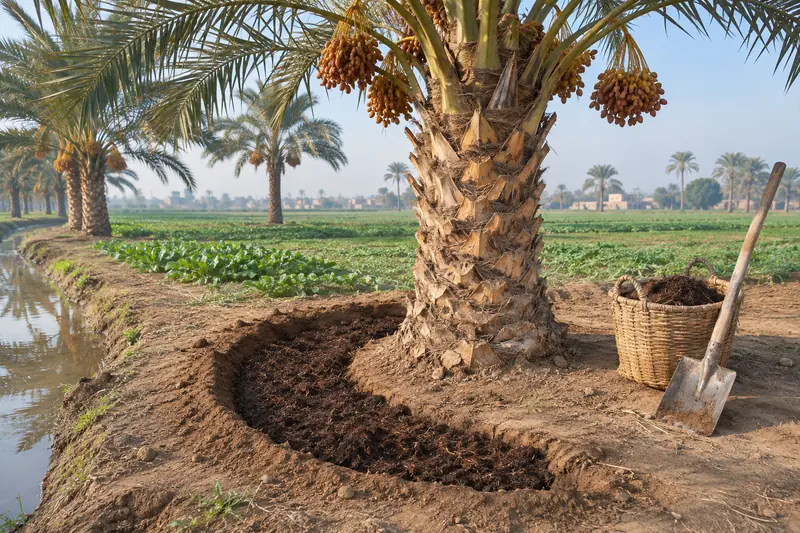
- Poor sandy land with mild salinity: organic matter comes first, and gypsum acts mainly as a calcium and sulphur source. For the published guidance on organic feeding in sandy land, see how to fertilize date palms.
- Not sure: test before buying a single ton.
Our organic options are priced per ton: local livestock manure at 275 EGP, raw livestock manure at 375 EGP and plant and animal compost at 650 EGP, with more under livestock manure. Sales confirms prices at order time. If you want a published figure against chemical fertilizer costs, see organic or chemical fertilizer?.
A planning example for a small field
Suppose a 5-feddan field whose laboratory test shows salinity between 4 and 8 dS/m, high exchangeable sodium and poor infiltration, with a drain nearby. This is only to show the thinking, not a prescription:
- Gypsum: the Al-Ard table gives 2-5 tons per feddan for this band, so 10-25 tons for the field. At 470 EGP per ton the material is 4,700-11,750 EGP, and at 750 EGP per ton 7,500-18,750 EGP. The wide spread inside one band is exactly why you need the laboratory formula rather than an average of the published figures.
- Drainage and leaching: a cost that can exceed the gypsum if the drain needs cleaning or the field needs levelling. Ask about it before ordering.
- Organic matter: at about 4 tons of compost per feddan, the rate used in a quoted trial, that is 20 tons for the field: about 13,000 EGP at 650 EGP per ton, or about 5,500 EGP of local livestock manure at 275 EGP per ton, material only. That is a trial rate, not an Egyptian standard for salty land.
The most important point is that this total is not “the cost of reclamation”. It is the materials line only. The rest is drainage, water, labour and a season of lower income or a salt-tolerant crop. Add it all up with your agronomist before committing.
How to tell whether the field is improving
Do not judge by looks alone. The signs you can track:
- A fading white crust after leaching, remembering it can return if the water table is high.
- Better infiltration. On sodic soil water ponds and drains slowly. If it drains faster after gypsum and leaching, the sodium is probably falling.
- Laboratory numbers. This is the only conclusive evidence. Re-measure salinity and exchangeable sodium after the first season and compare. The sources advise testing before, during and after leaching.
- Germination of the tolerant crop. Oregon State says plants are most sensitive at germination, so poor emergence can mean salt still sits in the surface layer.
Reclamation can take more than one season, so do not expect everything to vanish after the first leaching irrigation.
When to start: a short calendar
- Now to December: laboratory tests, levelling, and checking the drains. None of this needs a crop in the ground. Order gypsum with enough lead time before spreading.
- Before winter sowing: if the land will carry barley or wheat, which are tolerant in the Oregon table, arrange gypsum and leaching before sowing, not after.
- After the season: retest, then decide whether to repeat gypsum at a lower rate. The Al-Ard table describes yearly application on the lower-salinity bands.
We suggest keeping a record of application dates, quantities and lab results for each plot. After two seasons you will know which dose actually worked on your land.
Common mistakes
Buying gypsum for a purely saline field. Oregon State says gypsum does not help reclaim saline soil because it adds salt.
Gypsum without drainage. Without drainage the displaced sodium cannot leave, the water table rises and the salt returns to the surface.
Leaching with salty water. Leaching water must be less saline than the soil solution, ideally fresh.
Heavy doses of immature manure without a test. Some organic fertilizers carry salt. Ask and test.
Overdoing the gypsum. The Egyptian article warns that too much lowers the cation exchange capacity.
Letting saline soil turn alkaline during leaching. The article flags this risk, which is why exchangeable sodium is checked during reclamation and not only at the end.
Judging by eye. A white crust does not tell you the type.
What to ask your supplier
- What is the purity and fineness of the gypsum? Egyptian sources describe fine gypsum free of chlorides. Ask for the data available on each product.
- What is the real weight of a load? Do not accept a “lorry” or a “metre” without a weight.
- Is the manure mature? Mature manure is dark, crumbly and earthy-smelling.
- What is its moisture? Wet manure means paying for water.
- How long will delivery to my governorate take, and what moves the price? Quantity, distance and product all matter.
Where our knowledge stops
We found no published Egyptian study in our search of 14 November 2026 that gives one dose of gypsum and organic matter together for all soils. Our rates come from an advisory article published in 2016, extension publications from American universities working under different conditions, and trials at specific sites. Treat every figure as a planning range and let your soil analysis and agronomist set the real quantity. We do not promise that salinity will clear in one season or that yields will rise: reclamation takes seasons and depends on drainage and irrigation water quality.
Order gypsum and organic matter
When you have fixed the quantity after testing, choose the product by the ton and your governorate on the order page. It opens a WhatsApp message with a reference number, and sales confirms the price, availability and delivery date. We deliver to every governorate in Egypt and have worked in organic fertilizer and soil improvement since 1984. To browse first, open the shop, or contact us on WhatsApp and ask which product suits your land.
FAQ
Does agricultural gypsum fix salty soil?
It fixes sodic soil, where exchangeable sodium is high. For purely saline soil the main cure is drainage and leaching with water, and gypsum does not help because it adds salt, as Oregon State University explains. A lab test decides which you have.
How much gypsum does a feddan need?
The Al-Ard article quotes 0.5-1.5 tons yearly below 4 dS/m, 2-5 tons between 4 and 8, and 5-8 tons between 8 and 12. The exact figure comes from the formula using your laboratory result.
Should I add organic matter before or after leaching?
Sources recommend organic matter during reclamation to improve structure but give no single timing. Ask your agronomist, and watch the salt content of the manure itself.
Does gypsum work on sandy soil?
On sandy soil it mostly supplies calcium and sulphur rather than displacing sodium, according to general sources. Test the soil first.