Improving Sandy and Reclaimed Desert Soil with Compost and Gypsum
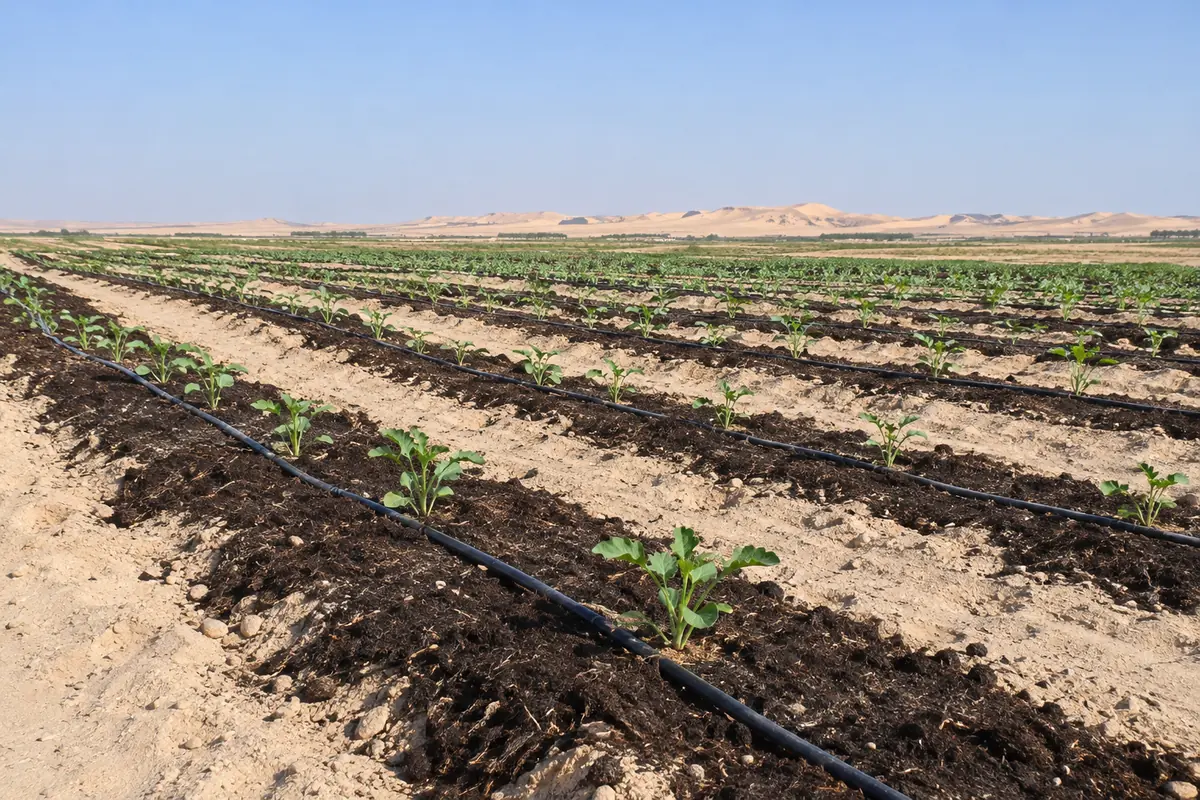
To improve sandy soil, start with organic matter: well-rotted farmyard manure or mature compost raises the soil’s ability to hold water and nutrients. Then use drip irrigation and split your fertilizing into small doses. Agricultural gypsum plays a smaller part in sand: it mainly supplies calcium and sulphur, and it does not fix sodium the way it does in heavy clay.
Sandy and newly reclaimed desert land can grow a wide range of crops, but it keeps almost nothing. Water drains fast, and mineral fertilizer washes away with irrigation before the plant uses it. A grower who applies only mineral fertilizer pays every season and sees the same soil year after year. This article covers what published sources say about rates, how to choose between farmyard manure, compost and poultry manure, when gypsum helps, and what to check before you buy.
Why sandy soil struggles
Egyptian agricultural sources (Mawdoo3, Alfilahia, Hundzsoil Egypt) describe sandy soil as:
- low in organic matter
- poor at holding mineral fertilizer, which is lost with irrigation water
- in need of organic matter, split fertilizing and well-managed irrigation
Reviews of Egypt’s new lands, including the FAO working paper (read on 13 November 2026), note that many of these soils are sand or loamy sand.
Organic matter does the heavy lifting
Organic matter is the part that mineral fertilizer cannot replace. The sources report that adding it to sandy soil improves water retention and raises nitrogen and soil microbes, and that combining organic and mineral fertilizer raises how well the plant uses the fertilizer.
Rates quoted in the literature
These are ranges quoted by Egyptian and international sources, not our recommendation. Adjust by a soil test and your local agronomist’s advice:
| Source | What it says |
|---|---|
| Egyptian agricultural sites (Mawdoo3, Alfilahia) | Farmyard manure, silt or other organic matter at about 30 to 40 m³ per feddan for sandy soil |
| MEL/ICARDA, Resource Management in the New Lands of Egypt (read on 13 November 2026) | About 15 to 20 m³ of manure, or compost with 50 to 58% organic matter, gives adequate planting conditions |
| Egyptian wheat extension articles (Elaard, Elbalad, Agrimisr) | On new sandy land the usual rate can be raised by 20 to 50% |
The spread between figures is normal. It shifts with water quality, crop, age of the land and the manure itself.
Farmyard manure, compost or poultry manure?
Sources such as Alukah and Al-Watan draw these distinctions:
- Compost is decomposed plant material and is good for water retention in sand. Immature compost with a high carbon-to-nitrogen ratio can hurt growth, so read how to tell when compost is mature.
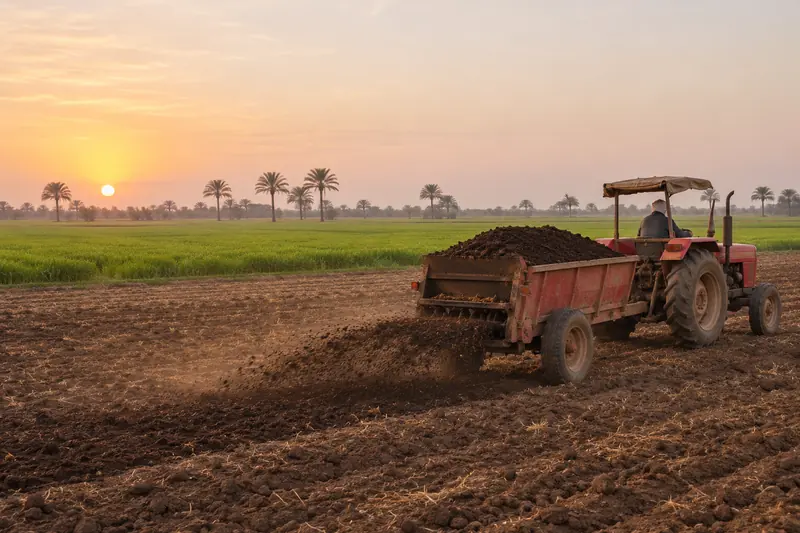
- Livestock manure (cattle, sheep, horse) improves soil structure, and its composition depends on the animal, the age and the storage.
- Poultry manure is rich in nitrogen and phosphorus, but it is strong and fresh material can burn plants; see does chicken manure burn plants.
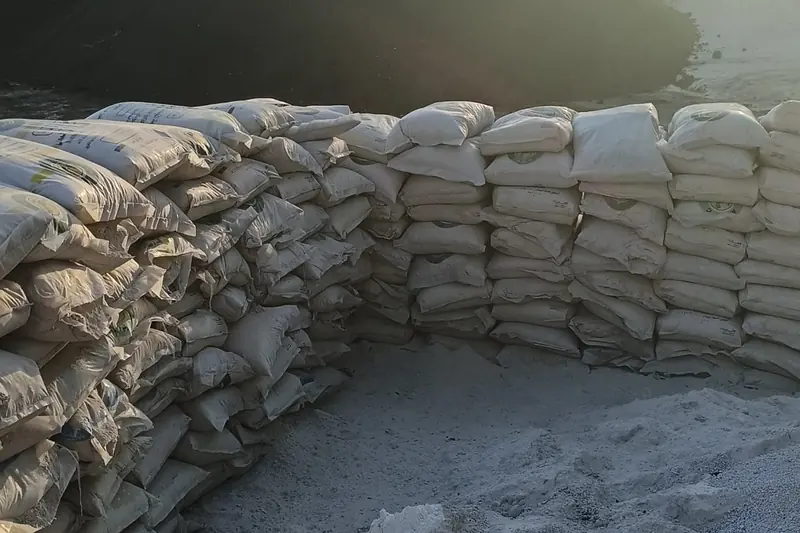
For livestock manure we sell local livestock manure at 275 EGP per ton and raw livestock manure at 375 EGP per ton. For compost there is plant and animal compost at 650 EGP per ton. Browse the compost and blends range and the livestock manure range. Prices are per ton, confirmed by sales at order time. We do not publish analysis figures for any product in this article; ask the sales team what data is available before you decide.
The salt warning
Sources point out that organic fertilizers can be high in salts and that growers should watch soil salinity, especially near the coast. If your land or irrigation water is already salty, adding a lot of material with unknown salt content can create a new problem. Test the soil and water first, split the application, and do not raise the dose in one jump.
What is gypsum really doing in sand?
Some growers treat gypsum as a cure for every soil. Sources, including the SmartAgri gypsum article, say agricultural gypsum displaces sodium with calcium mainly in heavy clay and sodic soils. In sandy soil its main job is to supply calcium and sulphur, not to repair sodium. For wider background on reclaiming saline-sodic soil in Egypt, see the Springer chapter (read on 13 November 2026).
The same sources advise high-purity (85 to 95%), finely ground gypsum. Ask any supplier about purity and fineness before you buy; we will tell you what information we hold for each product.
We supply Sinai agricultural gypsum at 750 EGP per ton and Abu Zaabal agricultural gypsum at 470 EGP per ton. The whole range is under agricultural gypsum.
Drip irrigation and split fertilizing
Sources recommend drip irrigation on sandy land, with fertilizer split into several doses and chelated micronutrients. In practice: if sand loses fertilizer with water, give the plant smaller amounts at shorter intervals rather than one big dose.
What the trials found
The sources report scattered trials. They are not a guarantee for your field, but they show the direction:
- On sandy land at South Tahreer, green manure and compost raised organic matter, nitrogen and microbes (reported by MEL/ICARDA).
- Date palm residues are about 80% organic matter, and in one trial palm compost at 30 tonnes per hectare improved organic matter and water retention.
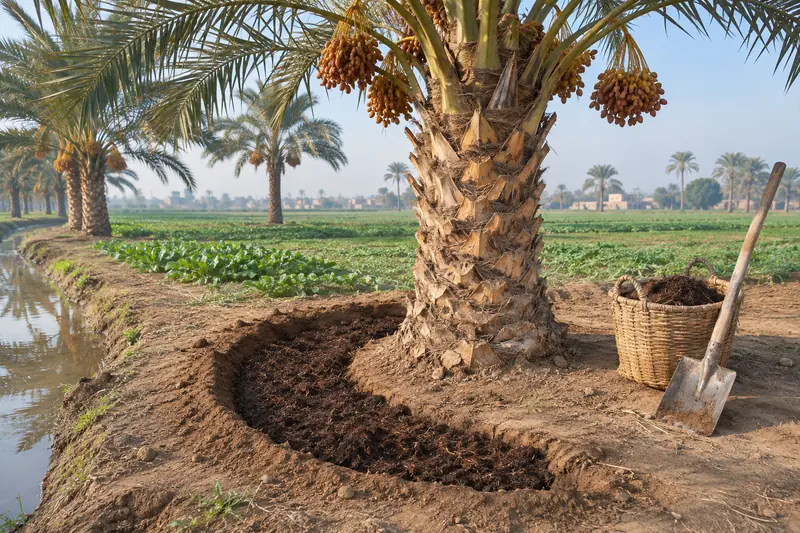
- An oasis review cites more than 30 kg of compost per palm every 2 to 3 years, and found that higher compost rates, alone or with mineral fertilizer, improved soil chemistry. Some of these studies come from Tunisia and other oases, so take them as direction only.
- In the Siwa trial (Desert Research Center), mineral fertilizer plus sheep manure improved leaves, bunches and sugars, and 100 kg of farmyard manure per palm improved nutrient uptake.
The lesson is that organic matter builds up over seasons, not within a week. For palms in particular, see fertilizing date palms with organic manure.
Do not replace mineral fertilizer outright
The sources do not ask you to drop mineral fertilizer. They say organic and mineral together raise plant use efficiency, because the organic part holds nutrients that sand would otherwise lose. If you are cutting mineral fertilizer to save money, judge the result over two or three seasons, not one.
Mistakes that keep repeating
- Spreading fresh manure right before planting and burning seedlings.
- Relying on gypsum alone as a substitute for organic matter.
- Leaving sand without organic matter and only irrigating more often.
- Ignoring water salinity under drip irrigation.
- Buying by eye instead of by the ton, which makes a per-feddan rate impossible to calculate.
Test first
Start with the analysis, not the quantity. Test the soil and the irrigation water for salinity, pH and nutrients. The ranges above are only a starting point for a conversation with your agronomist. New land differs from old land, and every field has its own analysis.
A simple plan for the first season
- Test soil and water.
- Choose the organic material: mature compost or well-rotted livestock manure. Avoid fresh.
- Spread it well before planting and mix it into the top layer.
- Set up or check the drip system and split the fertilizing.
- Add gypsum only if the test shows a need for calcium or sulphur.
- Watch salinity and test again after a season.
FAQ
How much manure should I add per feddan on sandy soil?
Sources quote ranges, such as 30 to 40 m³ per feddan from Egyptian agricultural sites and 15 to 20 m³ from MEL/ICARDA. These are not our recommendation. Set the rate with a soil test and your agronomist.
Does gypsum fix sandy soil?
Its main role in sand is to supply calcium and sulphur. Displacing sodium is a job for heavy clay and sodic soils. Ask first whether the test shows a need.
Compost or livestock manure?
Mature compost is good for holding water, and livestock manure improves structure. What matters most is that it is mature rather than fresh and that you know its salt level before applying. Ask us what is available.
Order or ask us
Choose the product, the quantity in tons and your governorate on the order page. A WhatsApp message with a reference number opens, and the sales team confirms price, quantity and delivery date. We deliver to all Egyptian governorates. For questions before you order, message us on WhatsApp 01012205022, browse the shop, or contact us.