Organic Fertilizer for Tomatoes and Peppers: Open Field and Tunnels
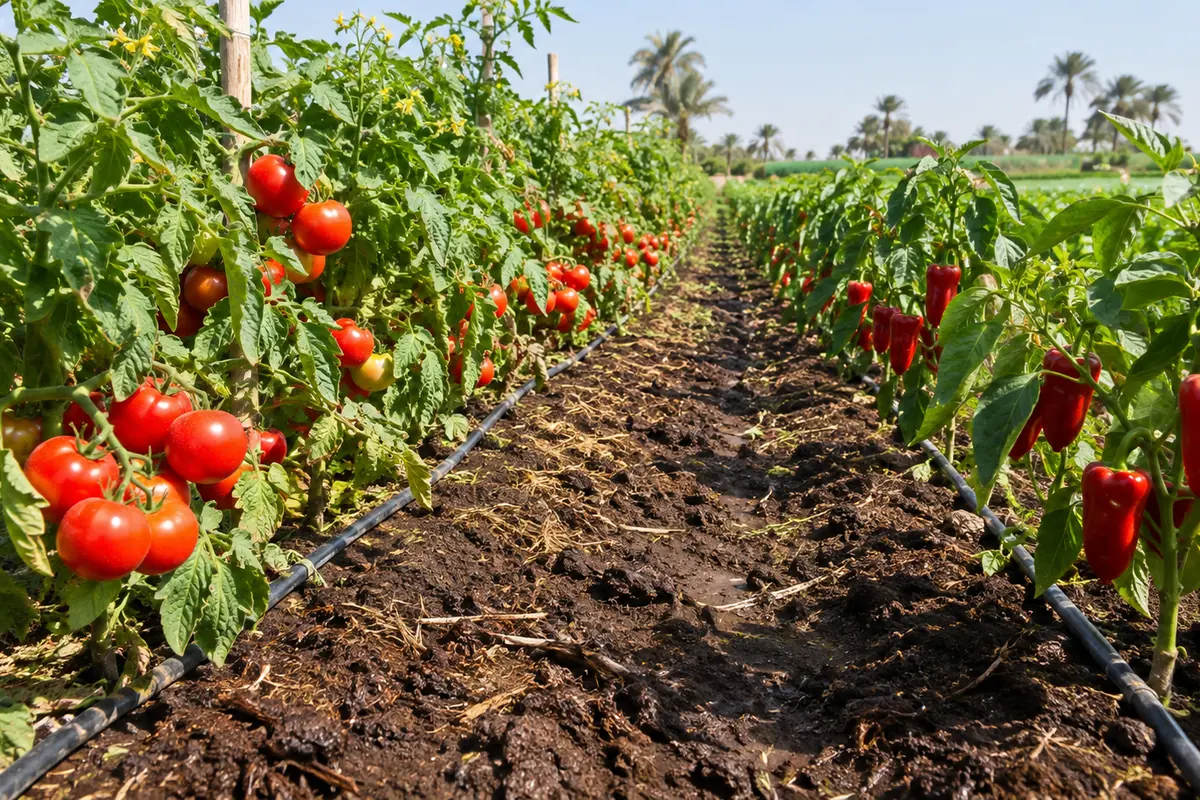
Egyptian sources agree that decomposed organic manure goes in before transplanting tomatoes and peppers, during land preparation and before the final plowing, at roughly 20 to 30 cubic meters per feddan. These are ranges quoted from published sources, not our recommendation, and a soil test should adjust them. What protects the fruit in these crops is less about adding more manure and more about balancing nitrogen and keeping irrigation even.
Why tomatoes and peppers are different from potatoes or wheat
Tomatoes and peppers are long-season crops. They carry fruit for weeks or months and live through swings in water and temperature the whole way. That changes the arithmetic in three ways.
First, roots need loose soil that holds even moisture. That is where manure helps, especially in reclaimed sandy land that does not hold water. Second, the crop draws nutrients in stages across the season, so organic manure before transplanting is only the first step, followed by a fertigation program on drip. Third, the fruit itself is sensitive to calcium shortage and irregular watering, which shows up as blossom end rot. We cover that below.
So this article does not read like a promise: manure improves soil and can reduce the need for some mineral inputs, but we do not promise a yield or a result, and we do not publish nutrient percentages for our products. Every figure below is quoted from a named source.
Where the numbers come from
We reviewed these pages on 14 November 2026. Some are old, so we treat dates with care:
- The tomato fertilizer requirements page on Almerja: organic manure rate, mineral fertilizer rates and how they are split.
- The pepper drip-irrigation page for sandy soils on Greenfue: land preparation, season windows and drip notes.
- The blossom end rot page from University of Maryland Extension: causes and prevention.
We also consulted a pepper article on Al-Ard (April 2021, Mohamed Adly), the tomato program from the company Royal Green Biotech, a news item on Akhbar El Yom about why tomato flowers drop, and the USDA National Organic Program rule on how long before harvest raw manure may be applied. Where one source disagrees with another, we say so.
When do you plant? Tomato and pepper seasons
Seasons decide when you prepare the land. This is what the sources say:
| Crop | Season | Quoted transplanting time |
|---|---|---|
| Pepper | early summer | February to March in Upper Egypt |
| Pepper | summer | March to April in Middle Egypt and the Delta |
| Pepper | late summer | April to May in the Delta and coast |
| Pepper | Nili (autumn) | July to August |
| Pepper | winter | November to December under plastic tunnels |
| Tomato | open field | February to April, and September to November, in northern Upper Egypt and the Delta (Royal Green program) |
For tunnels, press reports quote the Ministry of Agriculture’s vegetable department saying the tunnel tomato season runs from mid-November to mid-December, with the nursery sown about 40 to 45 days earlier. That is from a relatively old item, so check the current date for your area with the local extension office.
In practice: if you plan to transplant into tunnels in the coming weeks, land preparation is now. If you are aiming at a February or March crop, you have time, but booking manure early protects you from the seasonal rush.
How much organic manure before transplanting?
These are the figures exactly as the sources give them:
| Source | Case | Quoted figure |
|---|---|---|
| Almerja (tomato fertilizer requirements) | tomatoes in Egypt | 20 to 30 m³ per feddan, added when the field is prepared |
| Royal Green Biotech program | tomatoes | 20 to 30 (the page does not give the unit, likely cubic meters) of decomposed farmyard manure or compost, plus 3 sacks of superphosphate and 3 sacks of agricultural sulfur |
| Al-Ard (pepper, April 2021) | peppers | 20 to 30 m³ of decomposed organic manure, mixed and added before the second plowing |
| Greenfue (pepper on drip) | sandy soil, drip | 20 m³ per feddan with 300 kg superphosphate and 50 kg agricultural sulfur during plowing |
For tunnels and greenhouses we do not have a documented figure from a source we can rely on. Some forums give numbers, but we found no named published source behind them, so we do not repeat them. The safe rule is to ask your local extension agronomist what is right for your tunnel or house.
Three notes for reading the table
First, 20 to 30 m³ per feddan is a volume, and suppliers usually sell by weight. A cubic meter of manure does not weigh a fixed amount: it changes with moisture and with what the material is. Ask your supplier what a cubic meter of the actual product weighs, then work in tons. Al Omariya sells by the ton.
Second, the Royal Green page gives no unit, so do not rely on that line alone.
Third, for sandy soil under drip, the sources add superphosphate and sulfur with the manure during plowing. Raise that with your agronomist. They decide the rate from a soil test and the soil’s pH.
Our products, priced per ton
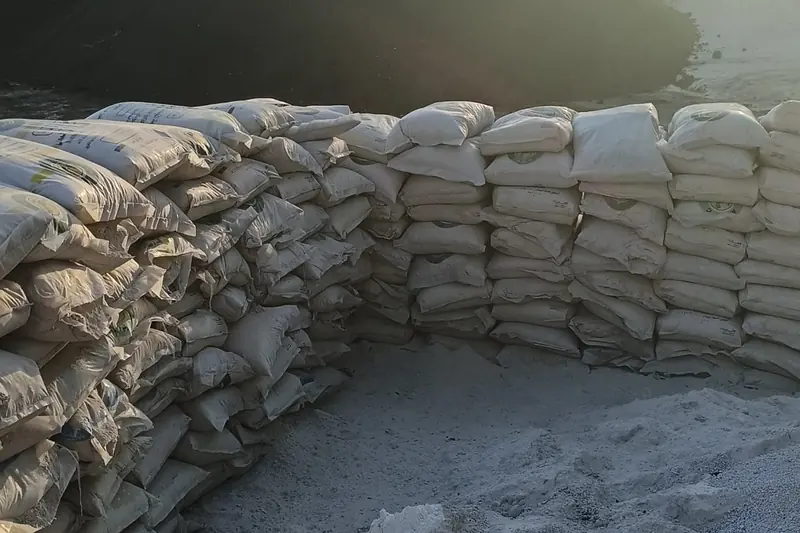
The sources describe decomposed farmyard manure or compost. At Al Omariya we sell the following by the ton, and sales confirms the price at order time:
- Local livestock manure: 275 EGP per ton
- Plant and animal compost: 650 EGP per ton
- Al Omariya economy blend: 750 EGP per ton
- Al Omariya regular blend: 950 EGP per ton
- Poultry mix: 750 EGP per ton
More are listed under poultry manure and compost and blends. We do not publish lab figures or nutrient percentages for our products here. If you need data on a specific product, ask the sales team. The right choice depends on soil type and condition, your irrigation system and your budget.
Poultry manure on tomatoes and peppers: an opportunity and a risk
Many vegetable growers lean toward poultry litter because it is richer in nitrogen, and some programs use it in place of part of the farmyard manure. But Egyptian sources warn that fresh or poorly decomposed manure can burn roots and seedlings, and a young transplant is more exposed than an established plant.
What we say plainly: do not put fresh poultry manure down a few days before transplanting, keep the material off the roots, and do not exceed the quantity your agronomist sets. We wrote about this in Does chicken manure burn plants?.
There is one more rule for growers who sell to buyers that require organic production. The USDA National Organic Program requires at least 90 days between applying raw manure and harvesting crops whose edible part does not touch the soil, such as tomatoes and peppers, and 120 days for crops that do, such as potatoes. That applies to people working inside that system and is not a requirement on every grower. If certification is your goal, read Organic farming certification in Egypt first.
Too much nitrogen works against you
The most common mistake with vegetables is pushing nitrogen in search of a huge plant. An Egyptian agricultural expert quoted by Akhbar El Yom lists excess nitrogen, applied to speed growth and swell fruit, among the causes of flower drop, along with calcium, potassium and phosphorus falling below the right levels. The same item says fruit set stops if the temperature falls below 17 degrees or rises above 34.
University of Maryland Extension also lists excess nitrogen among the factors that encourage blossom end rot. That matters for anyone adding nitrogen-rich poultry litter on top of a full mineral program: each side may think it is “reducing the dose” while the total is high. Count the manure inside the program, not on top of it.
Blossom end rot: what extension says
Blossom end rot is a dark, sunken patch at the blossom end of the fruit, away from the stem. It hits tomatoes, peppers, eggplant and others. According to University of Maryland Extension it is caused by a shortage of calcium in the enlarging fruit, and these factors make it worse: low soil pH, low soil calcium, irregular or shallow watering, drought and excess nitrogen.
On prevention, the university passes on these steps:
- Keep soil pH between 6.3 and 6.8.
- Mix a quarter cup of gypsum into each planting hole before transplanting (this is for small plantings).
- Water regularly and deeply, if the soil has enough calcium.
- A calcium chloride spray may give temporary relief.
Another source, a published lecture from Sohag University, says that light watering at close intervals beats widely spaced watering, to avoid fruit cracking and blossom end rot. Adding calcium does not solve the problem if irrigation is the cause.
What we add: agricultural gypsum is a source of calcium and sulfur, and a soil test is what tells you whether your land needs it and in what quantity. We have Sinai agricultural gypsum at 750 EGP per ton and Abu Zaabal agricultural gypsum at 470 EGP per ton, and we do not quote purity or lab results here. For what gypsum does on saline land, see Reclaiming salty soil.
Salinity and irrigation water quality
The Greenfue pepper page says irrigation water salinity should not exceed 1,000 ppm, and that drip irrigation should be at close intervals with each irrigation light, so roots do not rot. Manure can add salts depending on its source. If your soil or water is saline, take a sample of the manure, ask about a salinity test, and review the fertilizer plan with your agronomist.
Land preparation, step by step
1) First plowing and leveling
Breaking clods and leveling stop water collecting in hollows, and standing water means root rot.
2) Spread and mix the manure
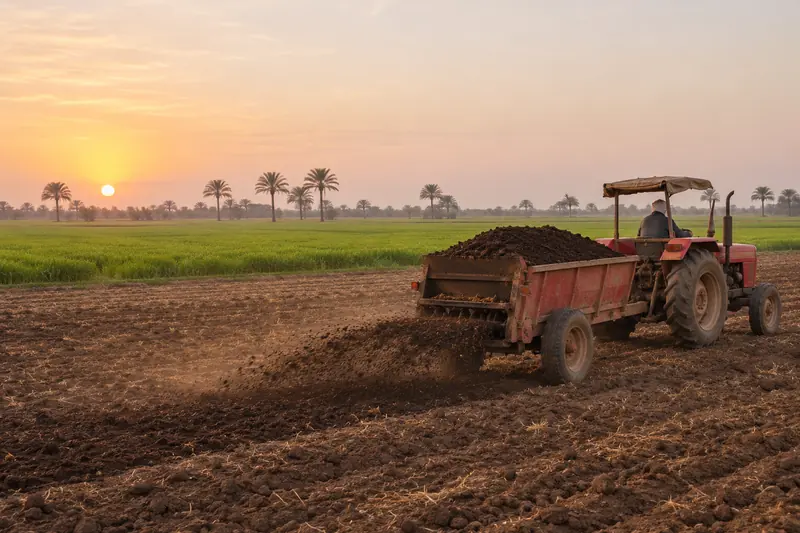
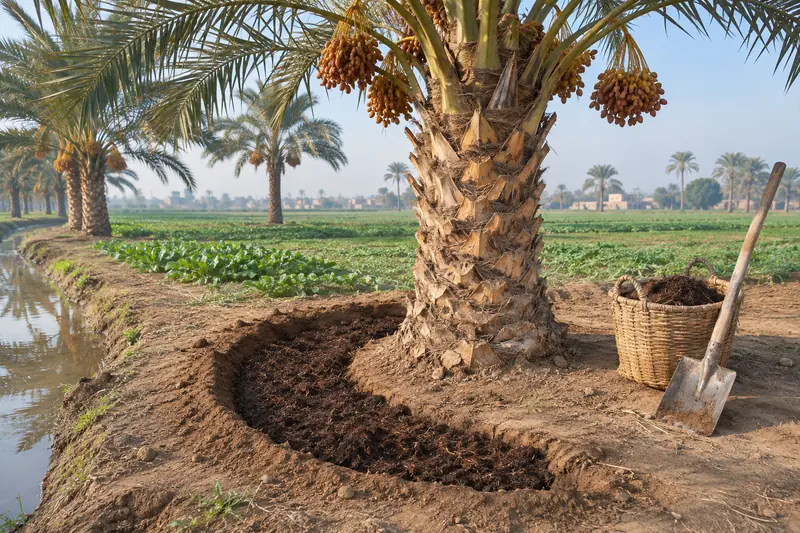
The decomposed manure goes on before the final plowing, according to the pepper article on Al-Ard, which matches the Almerja tomato page. Spreading several days before transplanting is better than on transplanting day. For practical details, see how to store and spread manure.
3) Add superphosphate and sulfur if your agronomist recommends them
The published figures: 300 kg of superphosphate and 50 kg of agricultural sulfur per feddan in sandy soil under drip (Greenfue), or 3 sacks of each (Royal Green). These come from websites and companies, and should only be applied after a soil test.
4) Mark rows and lay the drip lines
The Greenfue page describes rows 90 to 100 cm wide, with transplants 10 to 15 cm from the drip line and 25 cm between plants in a staggered pattern. These are figures for sandy soil under drip, not for every soil or variety, so ask your agronomist about spacing for your variety.
5) Irrigate, then transplant
A first irrigation settles the soil before transplanting and shows you hollows and leaks.
What goes in after transplanting?
We do not provide a mineral program, because that is your agronomist’s job. The published programs share the same idea: a first week with humic or fulvic acid for rooting, then nitrogen and phosphorus up to flowering to build a healthy canopy, then at flowering and fruit set a fertilizer with ammonium nitrate or potassium and calcium. The Almerja page says mineral fertilizers are split into three doses, and with drip they are dissolved in the irrigation water and spread over many irrigations to improve uptake and avoid salt buildup.
One note to close this part: the main sources we used put organic manure before transplanting and give no rate for spreading it beside plants during the season, so we give no number for that. Putting undecomposed manure beside standing plants risks burning the roots, as the warnings about poultry fertilizers say. If you want to add something mid-season, ask your agronomist first. Keep manure for before transplanting and leave the season to the program they set.
Open field, tunnel or greenhouse: what really changes?
The biggest difference is not the manure quantity but how long the crop stays and what surrounds it. A tunnel crop spends a long winter season in the ground, so it can face cold, frost, late blight and fungal diseases, and constant ventilation is needed so humidity does not climb. That means good land preparation before the tunnel cannot be redone after transplanting. Soil under plastic is not easy to reach with fresh manure without disturbing the plants.
In an open field you have more room to adjust irrigation and fertilizing, but you are more exposed to temperature swings and rain. A greenhouse gives you more control, but mistakes multiply: salty soil or undecomposed manure inside a closed house does more damage. That is why we repeat the advice: take a sample of the manure before you buy, and test the quantity on a small plot before you roll it out across the area if the product is new to you.
Try it on a small plot first
If you are dealing with a new supplier or a new type of manure, here is a cheap method. Set aside a small plot equal to the rest of the land (same variety, same irrigation, same transplanting date), put the new manure on it at the quantity your agronomist sets, and write down the date, quantity and supplier. Compare seedling growth and fruit set against the rest of the field. After a season or two you know whether the manure suits your land, without risking the whole field. It is what we suggest to every new farmer who works with us as well.
A rough timeline for a tunnel crop transplanted in about a month
| Before transplanting | Action |
|---|---|
| 5 to 4 weeks | Soil and water test, agree the quantity with your agronomist, order the manure |
| 4 to 3 weeks | Receive and inspect it (color, smell, moisture) and store it away from rain |
| 3 to 2 weeks | First plowing, spread manure and superphosphate (if recommended) and mix them in |
| Last week | Final plowing, marking rows, laying drip lines, a trial irrigation |
| Transplanting day | Transplant onto the rows, then light irrigation |
The table is approximate, our own ordering of what the sources describe, and is not an official Ministry of Agriculture schedule.
Common mistakes
1) Undecomposed manure a few days before transplanting. A small seedling suffers more than an established plant. Leave a gap between mixing and transplanting, and make sure the manure is decomposed.
2) Nitrogen on top of nitrogen. Poultry litter on top of urea on top of ammonium nitrate means excess nitrogen, which the agricultural expert quoted by Akhbar El Yom lists among the causes of flower drop.
3) Swinging irrigation. A dry day followed by a flooded one means cracked fruit and blossom end rot. Steady drip is better.
4) Adding calcium to fix a watering problem. According to University of Maryland and Sohag University, regular water comes first.
5) Buying by the truck with no weight. Trucks differ in capacity. Order by weight in tons.
6) Repeating tomatoes, peppers and potatoes on the same land. They are in one plant family and share diseases. Rotation is the answer, and manure does not replace it. For the crop before or after, see organic fertilizer for potatoes.
7) Ignoring ventilation in the tunnel. Poor ventilation raises humidity and invites fungal disease. Manure does not treat that.
What to ask your supplier
- Which animal? Livestock, poultry or a mix, and in what share?
- How long has it been composting? Good manure is dark, crumbly and smells earthy.
- Is it free of weed seeds and larvae? Egyptian guidance makes this a condition of good manure.
- What is the moisture? Soaking-wet manure means you pay for water.
- Can I see a sample or a photo of the pile before loading?
- How is weight measured? Tons, truck loads or cubic meters?
- What is in the price? Transport, loading and the number of governorates all change it.
- Is there a salinity figure or a mix ratio? If not, ask for a small sample and test it on a small plot first.
We encourage you to ask every supplier these questions, us included. Our sales team answers questions about our own products and sends photos of current stock on WhatsApp.
A budget example
This is simple arithmetic on published prices, not a recommendation of a quantity. If your agronomist sets 10 tons for a plot:
- Local livestock manure at 275 EGP per ton: 2,750 EGP for the material.
- Plant and animal compost at 650 EGP per ton: 6,500 EGP.
- Poultry mix at 750 EGP per ton: 7,500 EGP.
- Al Omariya economy blend at 750 EGP per ton: 7,500 EGP.
These cover material only, without transport, loading or spreading, and final prices are confirmed by sales at order time. Compare what each option saves in your mineral program and what it costs to prepare and haul. For the wider comparison with mineral fertilizer, see Organic vs chemical fertilizer in 2026.
The short version
- Decide the season and transplanting date and count backward.
- Run soil and water tests and agree the quantity with your agronomist. The published figures revolve around 20 to 30 m³ per feddan.
- Buy decomposed manure by the ton, inspect it and take a sample.
- Spread it before the final plowing, and well away from transplanting day.
- Count the manure inside the nitrogen program, not on top of it.
- Keep irrigation even: it is the first protection against blossom end rot.
Order manure for your tomatoes and peppers
When you know the quantity, choose the product, tons and governorate on the order page. That opens a WhatsApp message with a reference number, and the sales team confirms price, availability and delivery date. We deliver to all Egyptian governorates and have worked with organic fertilizer since 1984. You can also browse the shop first, or contact us on WhatsApp and ask which product suits your soil and irrigation system.
FAQ
How much farmyard manure do tomatoes need before transplanting?
Egyptian sources quote about 20 to 30 m³ per feddan, added when the field is prepared. These are quoted ranges, so adjust them by soil test. For tunnels and greenhouses ask the local extension office, because we found no documented figure.
Is organic manure enough on its own for tomatoes and peppers?
The published programs combine it with mineral fertilizer split across the season, usually on drip. Manure improves the soil and counts inside the program.
What causes blossom end rot?
According to University of Maryland Extension, a shortage of calcium in the enlarging fruit, made worse by irregular watering, excess nitrogen and low pH. The first remedy is regular, deep watering plus a soil test.
Can I use poultry manure on tomatoes?
Yes, but only once fully decomposed, in an amount your agronomist sets, and away from young seedlings. Fresh manure burns, so read the burn article first.