Organic Feeding for Pomegranate and Guava Orchards in Winter
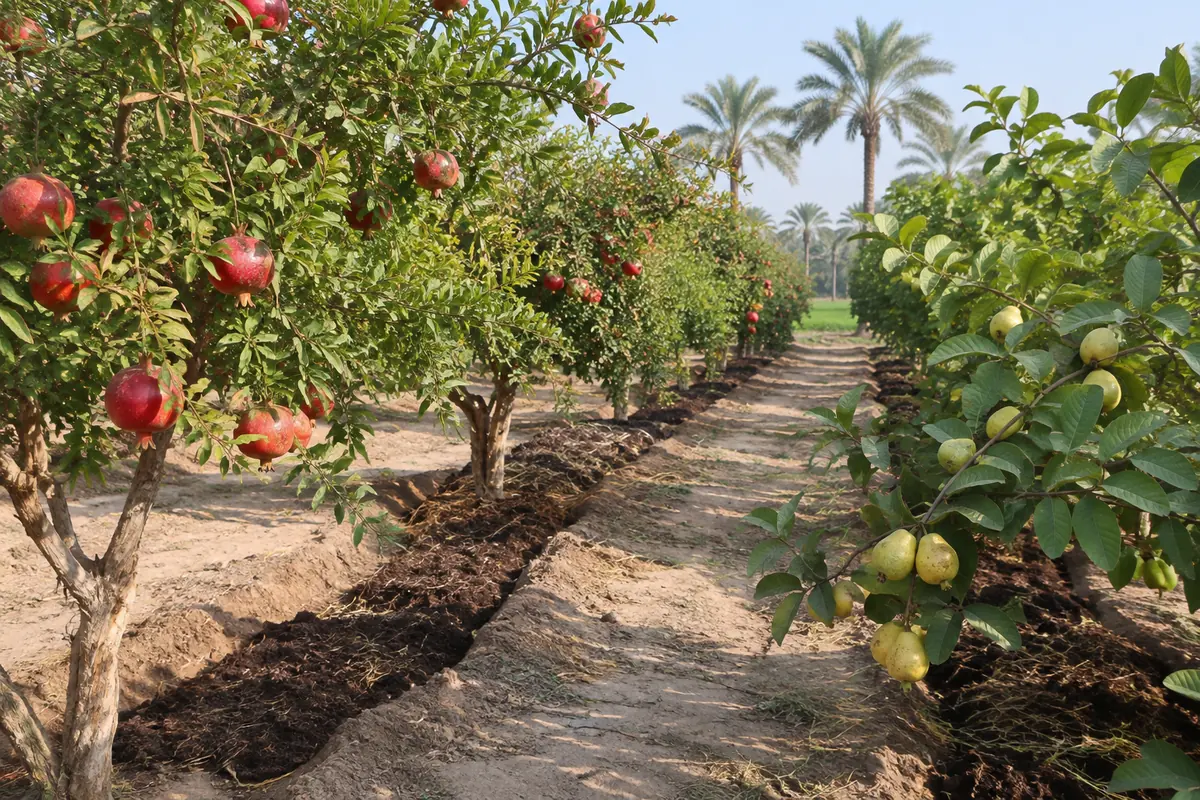
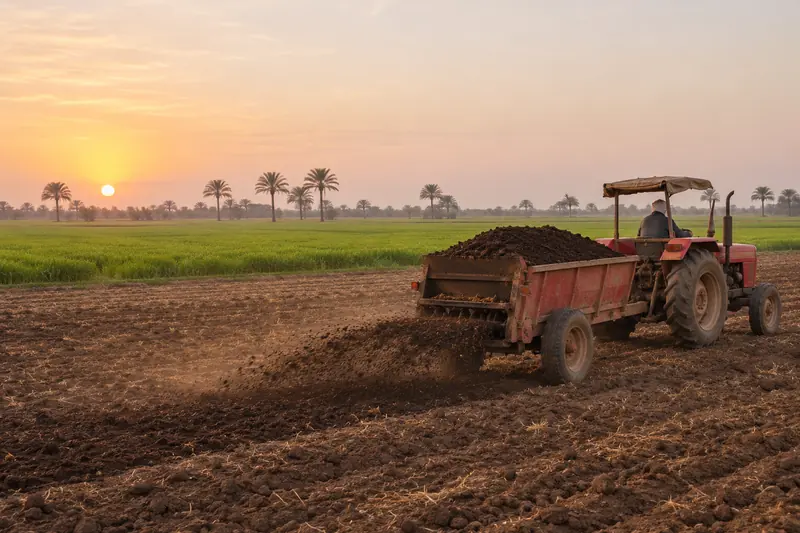
Egyptian extension sources place organic feeding of pomegranate and guava in winter: after pruning and before spring growth, roughly December to February. Well-rotted manure or compost goes into trenches or pits around the tree canopy, is mixed with the soil, covered and irrigated. The quantities quoted vary with tree age, soil and irrigation system, so every figure below is a range to confirm with a soil test and an agronomist.
Why winter is the working window
Pomegranate and guava are both fruit trees that most Egyptian growers prune in winter, and winter is also when the organic matter you bury has time to break down before the trees start to push new growth in spring. Manure and compost are not like a quick mineral top-up. They release slowly, and they need moisture and time in the soil.
Egyptian sources agree on the general pattern, though they do not agree on exact dates:
- For pomegranate, Al-Ard (10 February 2026, quoting Dr. Ahmed Helmy, Director of the Horticultural Crops Institute at the Agricultural Research Center) treats February as the key preparation period: finish winter pruning, then feed the trees before spring growth begins. Agriceg gives December for organic manure.
- For guava, an extension bulletin reported by Ahram Gate (a Ministry of Agriculture bulletin from the Horticulture Research Institute, dated 5 November 2020) lists manure and superphosphate among the November and winter operations, and says to start pruning in November. An Al-Ard article quotes a plant disease consultant who places manure for guava from January to early February.
So the practical window is about November to February, depending on the crop, the irrigation method and when you finish pruning. We are not agronomists, and these sources do not describe your orchard. Treat the months as a guide and plan your own date with an engineer who has seen your trees.
One note on honesty before we go further. Every rate and ratio in this article is quoted from a named source, not our own recommendation. We do not publish lab analyses or nutrient percentages for our products here, and nothing in this article promises a yield or fruit quality result.
Which products suit orchard feeding?
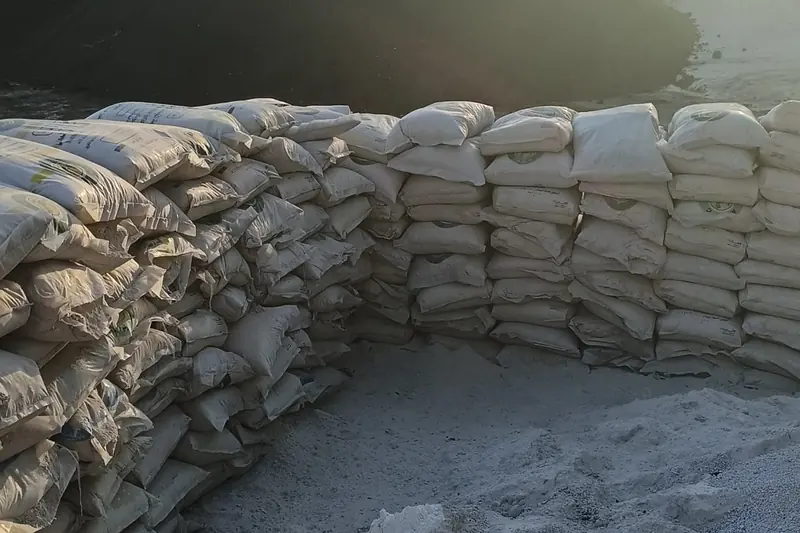
Orchard owners usually buy by the ton, so here are the options at Al Omariya Organic Fertilizers in Itay El Baroud, Beheira. Prices are per ton in Egyptian pounds and are confirmed by sales at order time:
- Local livestock manure: 275 EGP per ton
- Raw livestock manure: 375 EGP per ton
- Plant and animal compost: 650 EGP per ton
- Al Omariya economy blend: 750 EGP per ton
- Al Omariya regular blend: 950 EGP per ton
- Al Omariya complete blend: 1,050 EGP per ton
The full ranges are in livestock manure and compost and blends. Because manure is cheapest per ton and compost or blends cost more, the question is which fits your budget, your soil and the age of your trees. For the Egyptian figures quoted below, the reference material is “rotted farmyard manure” (the animal manure usually sold as balady manure) or “compost”, so livestock manure and compost are the natural starting points. Ask sales which product we have in the yard this week and what it looks and smells like.
If you are thinking of using poultry manure on fruit trees, read Does chicken manure burn plants? first. One Al-Ard guava article quoted below prefers poultry litter, but fresh or under-aged poultry manure is the usual cause of root burn.
Pomegranate: what the Egyptian sources quote
The Agricultural Research Center table (via Al-Ard, February 2026)
The most specific Egyptian figures we found come from the Al-Ard article quoting the Agricultural Research Center’s Horticultural Crops Institute. Per tree, by tree age:
| Item | Age 1-3 years | Age 4-6 years | Over 6 years |
|---|---|---|---|
| Rotted farmyard manure | 2 baskets | 3 baskets | 4 baskets |
| Compost | 5 kg | 10 kg | 15 kg |
| Superphosphate (15%) | 500 g | 1 kg | 1.5 kg |
The same article adds three conditions worth remembering: the manure must be well rotted and free of weeds and nematodes, the fertilizers are mixed together before burying, and the trenches are rotated to the other two sides of the tree the following year. The article does not give an exact date for feeding. It presents February as the preparation period before spring growth.
A “basket” (maqtaf) is a local unit and its weight depends on the manure. The article does not say how many kilograms it means, so we do not convert it. If you are buying by the ton, ask your supplier and your agronomist to agree on a weight per basket from your own pile before you calculate the order.
Other quoted rates
Agriceg, an engineering consultancy site, quotes 10 to 15 kg of organic manure per tree, adjusted for the soil type, repeated about every 3 years, with the application in December. That is a lower and less frequent figure than the Al-Ard table, which is a reminder that Egyptian sources do not agree, and both can be “right” for different soils, ages and irrigation systems.
Outside Egypt, ranges are wider. A review in the journal Agriculture (MDPI) on organic pomegranate farming, as summarized by our search, lists studies with 10 kg of cow-manure compost per tree, 20 kg of farmyard manure per tree before planting, and 25 kg of compost per tree combined with reduced mineral fertilizer. Indian farm guides quote anywhere from 10 kg to 50 kg of manure per tree depending on age. We mention these only to show how wide the numbers run. They come from other climates and soils, so they are not a basis for ordering in the Nile Delta.
What an Egyptian field trial found
There is one published study on pomegranate in Egypt that is worth reading. Abdel-Sattar and co-authors (PeerJ, 2021) worked in a private orchard on the North Coast in Matrouh Governorate, on 6-year-old “Wonderful” trees over two seasons (2018 and 2019). The organic manure at the full rate was 19.35 kg per tree each November, and treatments combined it with mineral fertilizer in different ratios, under three irrigation levels.
Their results, as published:
- The treatment with 75% mineral and 25% organic manure gave the highest fruit set (about 86%) and fruit retention (about 77%) and the highest yield per tree, about 53 kg per tree in both seasons.
- Marketable fruit was highest with 50% mineral and 50% organic manure, about 74%.
- The authors recommend 80% of reference evapotranspiration with the 75/25 mineral and organic mix where irrigation is costly.
- They note that the study covers one site and two seasons, so results may not transfer to other conditions.
We quote this as an example that growers often combine organic and mineral nutrition and do not rely on one alone. It is one orchard in one climate. It does not promise anything for your trees, and the mineral component in that trial is a decision for your agronomist.
Guava: what the Egyptian sources quote
Per tree
An Al-Ard guava program credited to plant disease consultant Eng. Salem Abu Khatal gives, for trees five years or older, 3 to 4 baskets of fully decomposed farmyard manure per tree (poultry litter preferred, in the source’s wording), mixed with 1 kg of superphosphate, applied in winter from January to early February. The source says to scatter everything under the tree and turn the soil to mix it in. The same recipe also includes a nematicide, which is a pest-control product, not a fertilizer, so we leave it out and recommend you speak to an agronomist about nematodes in your own orchard.
Per feddan
The Ministry of Agriculture’s extension sector bulletin (prepared by the Horticulture Research Institute), reported by Ahram Gate on 5 November 2020, quotes these figures for guava:
| Irrigation system | Organic manure per feddan | How to apply |
|---|---|---|
| Flood-irrigated trees | 10 m3 | Broadcast over the root zone, mix in, then irrigate to complete fermentation |
| Drip-irrigated trees | 10-15 m3 | Broadcast over the root-spread area |
For superphosphate the same bulletin says 200-250 kg per feddan for flood-irrigated bearing trees, 170 kg for young non-bearing trees mixed with the manure, and 250 kg per feddan for drip-irrigated bearing trees on newly reclaimed land, placed with the manure in two trenches on both sides of the canopy shadow and applied once in winter.
Note the source is from 2020. Doses and recommendations get updated, and the bulletin is a general one for the country. Ask your local agricultural extension office whether there is a newer bulletin for your governorate.
Converting per-feddan to per-tree
A rough check helps you see whether the two families of figures agree. Take a planting of about 4 x 4 m spacing, which one source puts at roughly 262 trees per feddan. Spreading 10 m3 over 262 trees is about 0.04 m3 per tree. How many kilograms that is depends on the manure’s density and moisture, which varies a lot between a dry, crumbly pile and a wet one. This is arithmetic on a quoted spacing, not a recommendation, and the point is simply that per-tree and per-feddan numbers are different ways of describing a similar order of magnitude. If you want to compare quotes from different suppliers, convert everything to tons per feddan using the actual weight of the load you receive. The rule is simple: weigh the load, or agree the weight in writing, because truck loads and cubic metres hide moisture.
The trench method for orchards
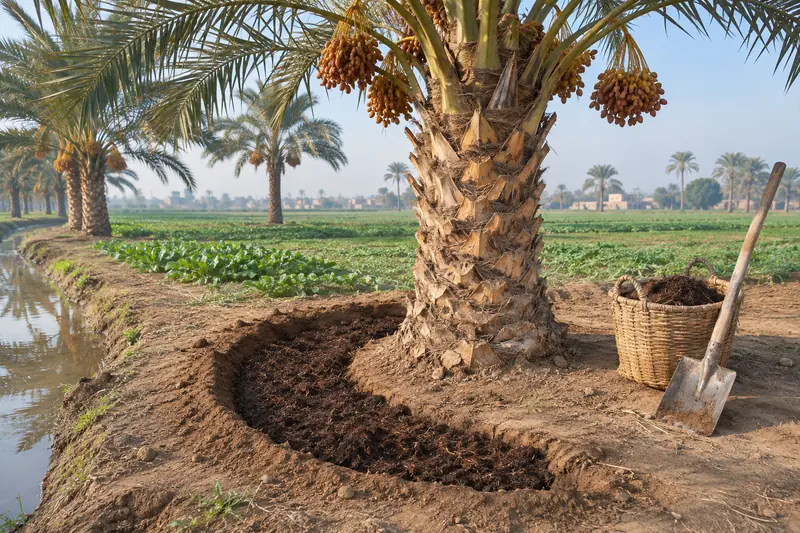
Both Egyptian sources describe placing the material in the soil rather than leaving it on the surface. Here is a clear sequence built from the Al-Ard pomegranate article:
- Finish pruning first. Remove dry, diseased and crossing branches, open the canopy to light and air, and take the cuttings out of the orchard to limit disease. The Al-Ard article also quotes a wound spray after pruning, which is a plant protection matter to settle with your agronomist.
- Mark the trench position. Two parallel trenches on opposite sides of the tree, each about 1 m long, 40-50 cm deep, starting 70-80 cm from the trunk. Keep material away from the trunk itself.
- Mix before burying. Combine the manure or compost with the superphosphate your agronomist specifies.
- Place, backfill and irrigate. Put the mix in the trenches, cover with the soil you dug out, and irrigate so the material starts to break down.
- Rotate the sides next year. The source says to move the trenches to the other two sides of the tree the following season.
With drip irrigation, the same Al-Ard summary describes digging a pit under the emitters and placing the organic material there so that the water reaches it. We found this in a search summary, so check the exact wording with your agronomist if you rely on it.
For guava under the Ministry bulletin’s broadcast method, the material is spread over the root zone, mixed into the soil and irrigated. That suits an orchard with flood irrigation where roots spread across the whole row. Choose by your irrigation system, not by habit.
Calculating an order for your orchard
This is plain arithmetic on the quoted figures. It is not a recommendation.
Suppose you have 200 pomegranate trees: 50 aged 1-3, 80 aged 4-6 and 70 older than 6 years, and you use compost at the Al-Ard rates.
- 50 trees x 5 kg = 250 kg
- 80 trees x 10 kg = 800 kg
- 70 trees x 15 kg = 1,050 kg
- Total = 2,100 kg, or 2.1 tons
At 650 EGP per ton for plant and animal compost, the material is about 1,365 EGP, before transport and labor. With farmyard manure the weight is a different matter because the table is in baskets: 50 x 2 + 80 x 3 + 70 x 4 = 620 baskets. The source does not give a basket weight, so we cannot turn 620 baskets into tons. Weigh a few baskets from your own pile first.
The lesson is that a recipe written in baskets, in cubic metres per feddan, and in kilograms per tree must be converted to tons before you ask for a price. Ask sales to confirm the price per ton and the delivery cost to your governorate, and tell them which product you are comparing against.
Common mistakes in orchard feeding
Feeding trees that are still under stress. If a tree shows disease or pest damage, the sources say to deal with the problem first. Manure does not cure it.
Using fresh manure. The research notes for Egyptian wheat and for date palm say manure must be well rotted and free of weeds, nematodes and pathogens. The same rule applies in the orchard. Fresh manure heats up in the soil and can burn roots.
Placing it against the trunk. The sources place trenches 70-80 cm from the pomegranate trunk and about 70-100 cm in date palm advice. Keep the material away from the trunk.
Dry application. Not irrigating after burying the material slows decomposition and keeps nutrients from reaching the roots.
Ignoring salinity. Some manures carry salts. Organic fertilizers can raise soil salinity if applied heavily, especially in coastal or already salty soils. If your land has a salinity problem, read Salty soil: how organic matter and gypsum work together before ordering large quantities.
Using one rate for every age. The Al-Ard table changes with age for a reason. Young trees have a small root zone, and a full dose is wasted or harmful.
Forgetting a record. Note the date, product and quantity per block. After two or three seasons you will see what suited your land.
What to ask your supplier
Manure and compost differ between yards and even between loads. Before you pay, ask:
- How long has this been aged or composted? Decomposed material is dark, crumbly and smells earthy, not sharp.
- What is the moisture? Wet manure means you pay for water by the ton.
- Can I see the pile or a photo? Ask for a sample or a recent picture of the exact pile.
- What is the price per ton, delivered to my governorate? Confirm it in writing, and confirm the load weight, not just the number of trucks.
- What is in the mix? Ask what the product is made from. If you need a lab analysis for a certificate or a program, ask whether one is available for that product.
- How should I store it until I use it? Keep it away from rain and standing water. For storage and spreading tips, see How to store and spread manure.
At Al Omariya we answer these on WhatsApp and can send photos of what is in the yard. We do not publish lab figures on this page.
A simple winter calendar
This calendar combines the quoted sources. It is a template to adjust, not a schedule to copy.
- November: Order early and start guava pruning if the Ministry bulletin applies to your area. Arrange the delivery date.
- December: Pomegranate organic manure application in the Agriceg source. Date palm and other orchard work also compete for labor, so plan ahead.
- January to early February: Guava manure and superphosphate in the Al-Ard guava program.
- February: The pomegranate preparation period described by the Horticultural Crops Institute director. Finish pruning, then feed the trees before spring growth.
- After every application: Irrigate, record the quantity and the date.
- Next winter: Rotate the trench sides for pomegranate, and check whether you need the yearly or every-three-year pattern.
Organic or chemical: the cost question
Egyptian chemical fertilizer prices rose through 2026 and organic fertilizer costs less per bag in retail listings, but the two are not the same thing and they do not replace each other one for one. Many programs combine them, as the Matrouh study did. For the price comparison and the figures reported in the press, see Organic vs chemical fertilizer in 2026. If your orchard includes date palms as well, How to fertilize date palms with organic manure covers the trench method and timing for palms. For olives on reclaimed land, see Olive trees: organic matter and gypsum.
Honest limits
- We found no single Ministry document that gives one rate for every orchard. The figures differ by source, date and irrigation system.
- Some sources are old. The guava bulletin is from November 2020, and the pomegranate figures are from a February 2026 news article quoting a research center official.
- Some figures came from search summaries of pages that we could not open in full, such as the drip pit method for pomegranate, and we marked them as such.
- Rates from India, Turkey and other countries do not transfer to Egyptian soils without checking.
- No one can promise fruit size, color or yield from manure alone. Water, pruning, pests, variety and weather all matter.
Order manure or compost for your orchard
When you know your quantity, choose the product, tons and governorate on the order page. That opens a WhatsApp message with a reference number, and the sales team confirms price, availability and delivery date. We deliver to all Egyptian governorates and have worked with organic fertilizer since 1984. You can also browse the shop first, or contact us on WhatsApp and ask which product suits your pomegranate or guava trees.
FAQ
When should I apply organic fertilizer to pomegranate trees?
Egyptian sources point to winter, after pruning and before spring growth. Agriceg quotes December, and the Agricultural Research Center’s Horticultural Crops Institute director, quoted by Al-Ard, treats February as the preparation period. Confirm the date with your agronomist.
How much manure does a pomegranate tree need?
The Al-Ard table quotes 2, 3 and 4 baskets of rotted farmyard manure, or 5, 10 and 15 kg of compost, for trees aged 1-3, 4-6 and over 6 years. Agriceg quotes 10-15 kg per tree about every 3 years. Adjust by a soil test.
What is the winter organic program for guava?
An Al-Ard program for trees aged five or more quotes 3-4 baskets of fully decomposed manure and 1 kg of superphosphate per tree from January to early February. The Ministry bulletin of November 2020 quotes 10 m3 per feddan for flood irrigation and 10-15 m3 for drip.
Can I use poultry manure on fruit trees?
Only if it is fully aged and composted. Fresh poultry manure can burn roots. Read Does chicken manure burn plants? before deciding.