Organic Fertilizer for Olive Trees in Egypt’s Reclaimed Land: Compost, Manure and Gypsum
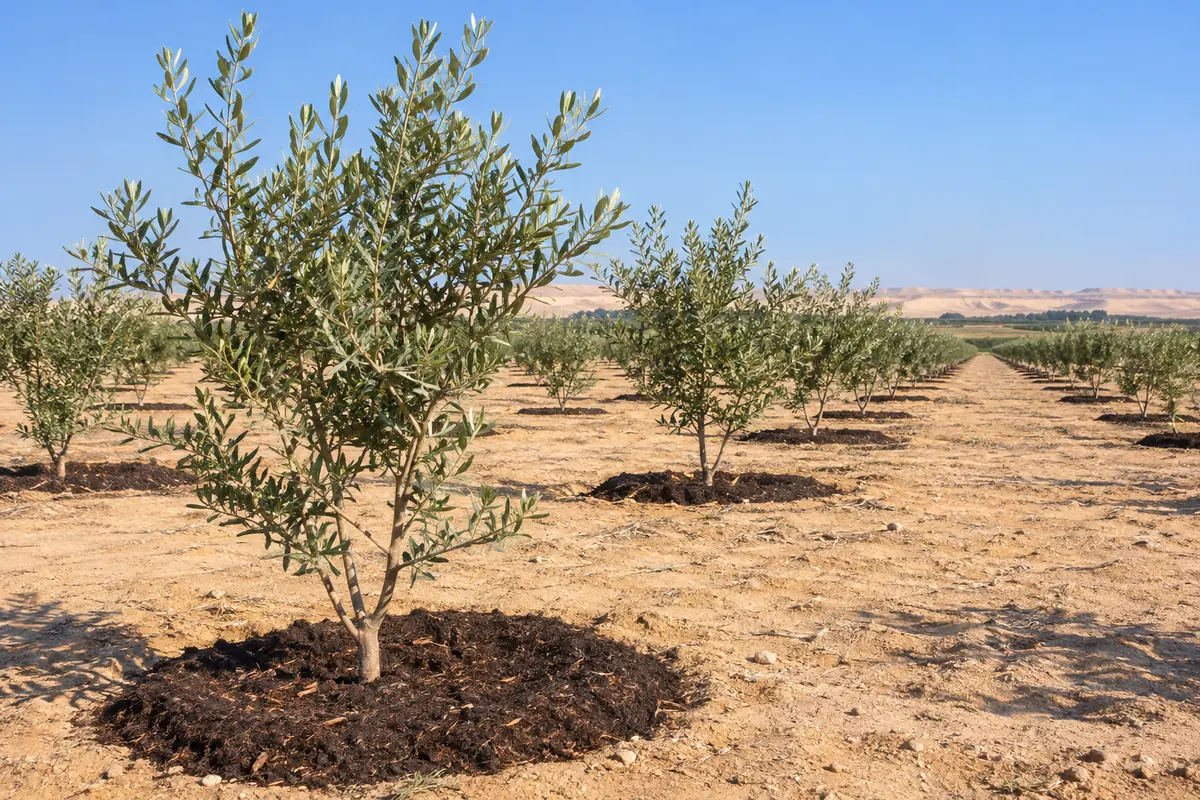
Egyptian extension sources place the main organic application for olives in autumn or early winter, as decomposed compost or manure buried in a trench under the edge of the canopy and moved to a new spot each time. Quoted amounts range from 25 to 50 kg per tree, and some sources work every two years. Treat every figure as a starting point and adjust it by a soil and leaf test.
Why olives in new land need organic matter
Most olive orchards planted in Egypt’s reclaimed areas sit on sand or loamy sand. That soil drains fast, holds very little water and loses mineral fertilizer to irrigation. The FAO working paper on the new lands, Resource Management in the New Lands of Egypt, describes many of these soils as sandy or loamy sand, and a manure or compost application is one of the standard ways to give the root zone something to hold on to.
A study of Koroneiki olives grown in Egyptian sandy soil, Nutrient Removal from Different Parts of Koroneiki Olive Trees Grown in Sandy Soil, reports very low organic matter in the soil it tested and notes that olives do well on soils with more than 1% organic matter. We only have the abstract-level summary of that paper, so read the full text if the number matters to your decision. The practical point is simple: a young orchard on pure sand usually starts far below that level, and a tree cannot build roots into a soil that dries out and washes through within hours.
Organic matter does three jobs for an olive tree on sand:
- It holds water and nutrients near the roots a little longer, so each irrigation goes further.
- It feeds the soil life that makes nutrients available over the season.
- It buffers the soil a little against swings in salinity and temperature.
What it does not do is replace a fertilizer program. Egyptian orchard guidance, such as the article by Dr. Alaa Gomaa of the Faculty of Agriculture at Suez Canal University published by Elaard in July 2020, always combines the organic application with phosphorus, potassium, sulphur and split nitrogen. We come back to that below.
Compost or manure: what suits olives
Olive growers in Egypt use two broad families of material. The first is decomposed livestock manure (cattle, sheep or mixed), which is cheaper per ton and widely available. The second is compost or a manure-based blend, which is usually more uniform and easier to spread. A third, poultry manure, is richer in nitrogen and needs more care. Read Does chicken manure burn plants? before choosing it for trees on drip, because fresh poultry manure near the roots can scorch them.
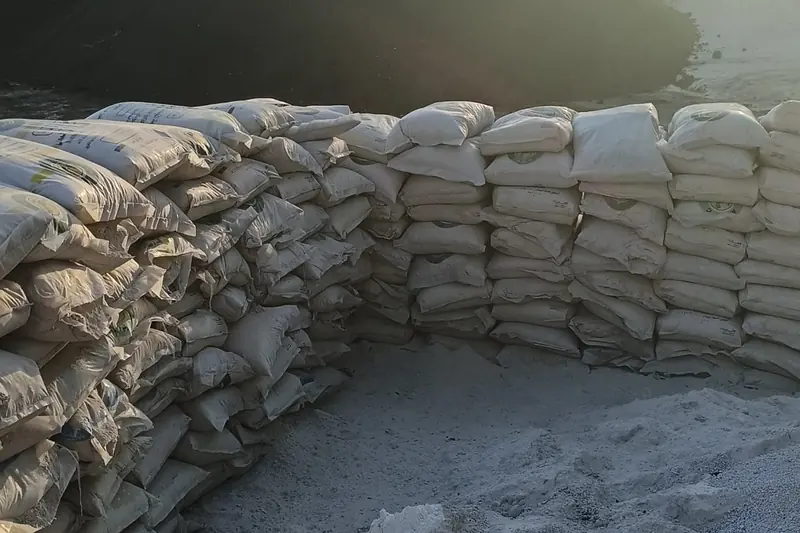
At Al Omariya the relevant products are priced per ton, and sales confirms the final price at order time:
- Local livestock manure: 275 EGP per ton
- Raw livestock manure: 375 EGP per ton
- Plant and animal compost: 650 EGP per ton
- Al Omariya economy blend: 750 EGP per ton
- Al Omariya complete blend: 1,050 EGP per ton
You can see the wider range under compost and blends and, for the agricultural gypsum discussed below, under agricultural gypsum. We do not publish lab figures or nutrient percentages for these products on this page. If you need to compare a specific product, ask the sales team for the details before you order.
What the sources quote per tree
Here is where honesty matters. There is no single Egyptian number for olives, because tree age, soil, water quality and irrigation system change the answer. The figures below come from named sources and are quoted, not recommended by us.
| Source | Quoted figure | Notes |
|---|---|---|
| Elaard, Dr. Alaa Gomaa, Suez Canal University (2020) | 6 tons of compost per feddan, equal to 40 kg per tree, every two years | Autumn or early winter, in trenches, with phosphorus and half the potassium |
| Sustinafrica, organic olive practice in Egypt | 25 kg compost per tree in December | Part of a winter service in an organic-practice project |
| Koroneiki study in Egyptian sandy soil (ResearchGate, link above) | 40 kg compost per tree | As listed in the study summary we could read |
| Compost-rate trial in Giza (ResearchGate) | 30 kg per tree gave the best result in that trial, followed by 15 kg | Combined with bio-fertilizer, humic acid and compost tea |
| Haifa Group crop guide | traditional growers add about 50 kg of manure per tree every 2-3 years | A fertilizer company guide, not an Egyptian extension bulletin |
| Trial on cv. Cyprus in Ismailia sandy soil (ResearchGate) | 10 kg of chicken manure per tree, both sides of the tree under drip | Poultry manure is stronger, hence the smaller quantity |
Three observations help you read this table.
First, the compost figures cluster between 25 and 40 kg per tree per application, and the manure figures sit higher at around 50 kg, which is consistent with manure being a less concentrated material. Do not read the difference as a competition between sources.
Second, the Giza trial found that more was not automatically better. A middle rate paired with other treatments did best in that experiment. That is one trial, not a rule, but it supports the habit of building up gradually and checking the tree’s response.
Third, the Elaard figure is the only one that links per-feddan and per-tree amounts: 6 tons per feddan at 40 kg per tree implies about 150 trees per feddan. If your spacing is wider, your per-feddan tonnage drops. Always calculate from your own tree count.
Timing: autumn to early winter
The Egyptian sources agree more on timing than on quantity. Elaard places the organic application in autumn or early winter, and a commercial source we read, Hundzsoil Egypt points to December or January, before the new growth cycle begins. The Sustinafrica project applied compost in December. Another source says late November after harvest.
So for most orchards the window is roughly from the end of harvest to January. That fits the logic used for other trees in this series: manure needs weeks in moist soil before roots can use it, so it goes in during the quiet season. You can read the same reasoning for palms in How to Fertilize Date Palms with Organic Manure and for citrus, mango and grapes in Winter Organic Feeding for Citrus, Mango and Grapes.
If you plan to feed in December, order in October or early November. Trucks and yards are busier in the weeks before the winter feeding season, and aged material is easier to find early.
The trench method
The same sources describe the same placement:
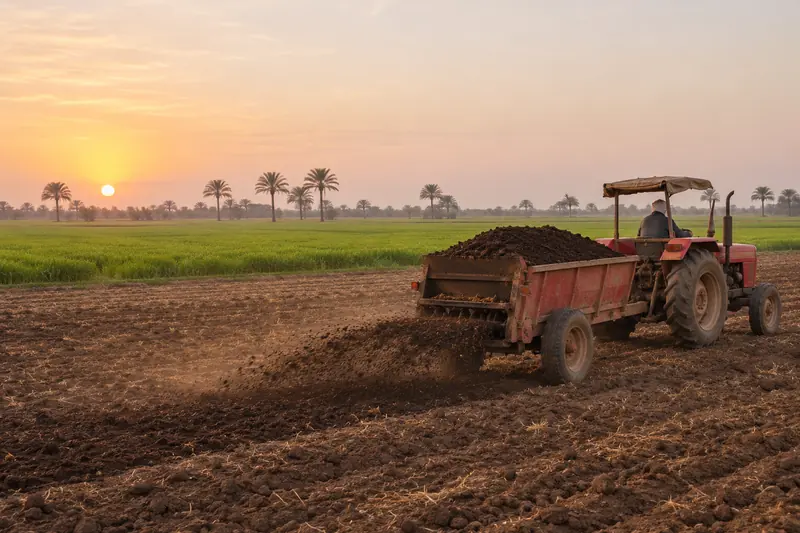
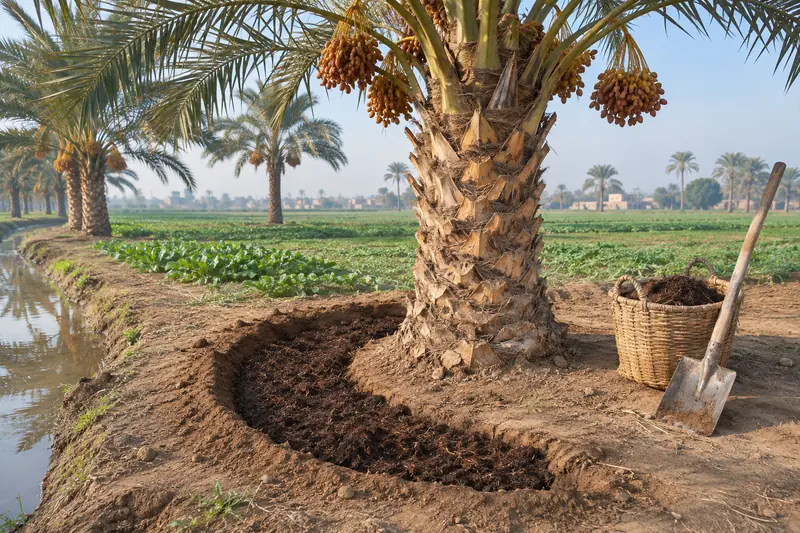
- Find the wet zone. On drip, this is the strip under the emitters. On basin irrigation, it is the area under the outer edge of the canopy. Elaard says to place the manure in trenches beneath the outer edge of the canopy, in the wetted zone.
- Dig a trench, not a hole at the trunk. Keep the material away from the trunk. A trench 30-40 cm deep is typical in citrus guidance, and the Elaard article asks for the manure to be placed at depth and covered, not left on the surface.
- Mix as the sources advise. Elaard says to mix the phosphorus and half of the potassium with the organic manure in autumn. For sulphur, it says to add 5 kg of agricultural sulphur per tree with the manure before backfilling, especially in calcareous soils and in land irrigated with saline water.
- Backfill and irrigate. Water straight after so the material starts to break down and settle.
- Move the trench next time. Elaard asks you to change the trench location with each application, keeping it in the wet zone. That spreads organic matter across the root area over the years.
A simple sketch helps: imagine the canopy as a circle. Dig a half-circle trench on the east side this year, and the west side two years later. Over six years you cover the whole ring.
Where gypsum fits, and where it does not
Agricultural gypsum is calcium sulphate. It is sold to farmers for two different reasons, and olive growers often mix them up.
Reason one: sodic or saline-sodic soil. When irrigation water or soil carries too much sodium, calcium from gypsum can displace sodium from the clay so that it washes out. The Springer chapter Reclamation of Saline-Sodic Soils for Sustainable Agriculture in Egypt covers this in Egyptian conditions. Reports on olives irrigated with sodic or saline-sodic water, summarized in the International Olive Council salinity module, say gypsum can help reduce the problem. There is also a trial in the Ismailia desert, on saline loamy sand irrigated with saline water, that tested sulphur, gypsum and farmyard manure on Picual olives.
Reason two: calcium and sulphur supply. In sandy soil that is not sodic, gypsum mainly provides calcium and sulphur. That is a minor benefit compared with the organic matter you are adding. Do not spend money on gypsum “to improve sand” without a soil analysis.
So the honest answer is: gypsum belongs in olive orchards where tests show high sodium, high SAR or an irrigation water problem. On clean sandy soil with good water it is optional. Quoted rates for sodic soil reclamation, such as 1-5 tons per acre by an Egyptian exporter and 5 tons per hectare by another listing, apply to heavy, sodic soils, not to an ordinary sandy orchard. We covered the sandy case in Improving Sandy and Reclaimed Desert Soil with Compost and Gypsum, and the saline case is the subject of Salty soil: how organic matter and gypsum work together.
If your test supports gypsum, we sell two types by the ton: Abu Zaabal agricultural gypsum at 470 EGP and Sinai agricultural gypsum at 750 EGP. Ask the sales team about purity and grind before you decide, since the sources we read recommend fine-ground, high-purity gypsum.
Salinity, drip lines and the salt trap
Olive is moderately tolerant of salt. The International Olive Council catalogue and other reviews we read describe minor yield loss at soil salinity in the range of 4-6 dS/m, and irrigation water up to about 5 dS/m for ordinary cultivars, with some cultivars, such as Picual, rated more tolerant. These figures vary by cultivar and are summarized from abstracts, so check the full paper for your variety.
Two cautions matter for organic fertilizers:
- Manure and compost can carry salts. The Egyptian sources on sandy soil warn that organic fertilizers can be high in salts and that you should watch soil salinity, especially near the coast. If your water is already salty, ask for the supplier’s electrical conductivity reading for the material.
- Drip lines concentrate salt. A long-term study of brackish-water drip irrigation in an olive orchard found salt building up above the drip line, between emitters, to levels above the olive threshold. Leaching irrigation matters, and a trench placed in the wet zone should be flushed by normal irrigation, not left dry.
This is also why Elaard recommends adding sulphur with the manure in lands irrigated with saline water, and why a leaf and soil test every year or two is cheaper than guessing.
A quick orchard calculation
This is arithmetic on the quoted figures, not a recommendation.
- A 10-feddan orchard at 150 trees per feddan has 1,500 trees.
- At 25 kg per tree, that is 37.5 tons.
- At 40 kg per tree, 60 tons.
- At 50 kg per tree, 75 tons.
With the Elaard every-two-years routine, you would apply to half the orchard each year, so a 10-feddan orchard needs 30 tons per year at 40 kg per tree.
For a rough material budget, 30 tons of local livestock manure at 275 EGP per ton is about 8,250 EGP, and 30 tons of plant and animal compost at 650 EGP is about 19,500 EGP, both before transport and labor. Final prices and delivery are confirmed by sales at order time. The gap between the two lines is the reason to ask what you are paying for: moisture, age, uniformity and how much of the pile is actually decomposed material.
Young trees versus bearing trees
The sources differ for young and bearing trees, and the safe approach is to scale.
- Trees in the first two or three years: Smaller quantities, applied close to the wet zone. Roots are shallow and the tree can be burned by strong material. Elaard’s nitrogen advice for flood-irrigated trees under three years is monthly small batches, which shows the same logic: little and often.
- Bearing trees: Larger trench applications every one or two years, plus the split mineral program.
- Old trees in rain-fed (baali) orchards: The Egyptian sources we read advise organic matter at 10-20 cubic metres per feddan in poor or newly reclaimed rain-fed land. Rain-fed trees depend on stored moisture, so organic matter has a bigger role there.
None of these amounts replaces an agronomist’s visit. A tree’s leaf color, shoot growth and previous crop load will tell a trained eye whether to raise or lower the application.
What to ask your supplier
Quality varies between yards. Before you pay, ask:
- How old is the material? Egyptian sources on other crops require manure to be well decomposed and free of weed seeds, larvae and pathogens. For trees, fresh manure placed in a trench can heat up and damage roots. See How to Tell Compost Is Mature for simple field checks: dark color, crumbly texture, earthy smell.
- What is the moisture? Wet material means you pay for water by the ton.
- Can I see a sample or a photo of the pile? Do not accept a verbal description.
- What is the electrical conductivity? Especially for orchards on saline water.
- Is it sold by weight? Order in tons, not truck loads, because trucks differ in size.
- What is the delivery plan? Confirm the date, the access road and who unloads.
If your orchard is big and you plan to buy for several seasons, the checklist in Buying Organic Fertilizer in Bulk from Egypt covers contracts, samples and testing.
Common mistakes
Putting manure against the trunk. It invites rot and disease and does little for roots that are out under the canopy edge.
Spreading it on the surface and leaving it. The sources ask for trenches and backfilling. Surface material dries and loses nitrogen.
Using the same trench every year. Elaard asks to change the location with each application.
Ignoring phosphorus, potassium and sulphur. Organic matter is the base, not the full program.
Skipping the soil and leaf test. Quoted ranges differ by a factor of two or more. A test tells you where your orchard sits.
Feeding in the wrong season. Autumn and early winter give the material time to work before spring growth.
Buying gypsum because it is cheap. Without a sodium or sulphur reason, the money is better spent on organic matter or a soil test.
A simple yearly calendar
- After harvest, October to November: soil and leaf test, order material, decide the trench side.
- Late November to January: dig trenches, mix phosphorus, half the potassium and sulphur with the organic material, backfill and irrigate.
- January to October: nitrogen in split batches or through the drip line, as in the Elaard schedule.
- Early June: second half of the potassium, per the same source.
- Next autumn: repeat on the other side, or skip a year if you follow the two-year routine.
Keep a plain record per plot: date, material, tons, trench side. After two or three seasons it tells you more than any article.
Order organic matter for your orchard
When your quantity is settled, choose the product, tons and governorate on the order page. It opens a WhatsApp message with a reference number, and the sales team confirms price, availability and delivery date. We deliver to all Egyptian governorates and have worked with organic fertilizer since 1984. You can also browse the shop first, or contact us on WhatsApp at 01012205022 to discuss which material suits your trees and your water.
To compare costs with mineral fertilizer, see Organic vs Chemical Fertilizer in 2026.
FAQ
How much organic fertilizer does one olive tree need?
The sources we found quote 25-40 kg of compost per tree per application, around 50 kg of manure every 2-3 years in one fertilizer-company guide, and 10 kg of chicken manure per tree in one Ismailia trial. Age, soil and irrigation change the answer, so fix the amount with a soil and leaf test.
When should I apply it?
Egyptian sources point to autumn or early winter, after harvest, up to December or January, in trenches under the canopy edge.
Do olive trees need gypsum?
Only where tests show sodium or water problems, or a calcium and sulphur need. On ordinary sandy soil with good water, gypsum is optional, and the organic matter does the main job.
Can I use poultry manure on olives?
It is stronger in nitrogen and can burn roots when fresh. The trial we cite used a much smaller quantity per tree, 10 kg, and placed it on both sides of the tree under drip. Use aged material and keep it away from the trunk.