How to Store and Spread Manure on a Field: Timing, Equipment and Safety
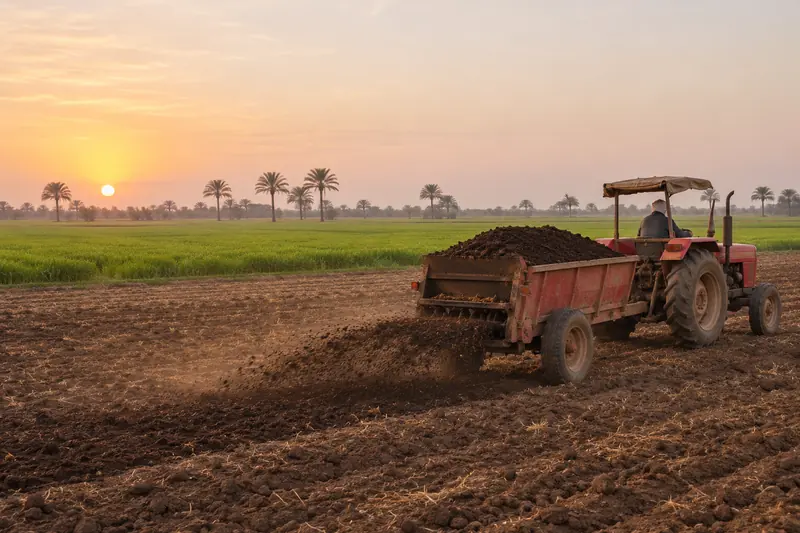
Spread manure evenly, on a measured rate, and work it into the soil quickly, because exposed manure loses nitrogen and uneven spreading wastes money. Keep any stored pile covered, on dry ground, away from irrigation canals. Calibrate your spreader instead of guessing, and treat closed pits and tanks as a lethal gas risk. The practices below come from named extension sources; adjust them with a soil test.
Why handling matters as much as buying
Most farmers spend their attention on which manure to buy and how many tons. Fewer think about what happens between the truck arriving and the manure being under the soil. That stretch is where a lot of value is lost. Ammonia escapes into the air from a dry pile, rain washes dark liquid out of a heap, wind scatters light material, and an uneven pass with the spreader leaves one strip of the field with double and the next with almost nothing.
None of this needs expensive equipment. It needs a few habits: choose where to put the pile, cover it, time the application, measure what the spreader really throws, and bury the manure soon after. This article walks through those habits for Egyptian conditions, using named sources, and says plainly where the sources stop and your own agronomist has to decide.
One note on sources before we start. Most of the detailed spreader and safety guidance we found comes from university extension services in the United States and Europe. The principles, such as weighing what the machine throws, apply anywhere. The numbers and units are theirs, so we quote them with their units and convert only where we say so. Egyptian farming sources are used for timing and incorporation.
If you are still choosing what to spread, our range starts with local livestock manure at 275 EGP per ton and raw livestock manure at 375 EGP per ton, with stronger options in poultry manure and livestock manure. Prices are per ton and confirmed by sales at order time.
Part 1: Storing manure before you spread it
The best storage is none
An Arabic farming guide on making farmyard manure, published by Elaard (checked on 14 November 2026), makes a point that surprises many people: the most reliable way to avoid losing the fertilizing value of manure is to move it straight to the field and work it in. Every day in a heap is a day of loss. The same guide says that when manure is carried to the field it should be spread quickly and covered by ploughing straight away.
In practice you cannot always spread on delivery day. The field may be wet, the tractor may be busy, the crop plan may say next month. So storage is often needed, even if only for a few days. The goal is to keep that period short and well managed.
Choosing the site
Think about water first, in both directions.
- Keep it away from canals and drains. Liquid that drains from a manure heap carries nutrients and organisms. Do not put the pile on the bank of an irrigation canal or at the low point of the field where water gathers.
- Choose firm, well-drained ground. A truck loaded with several tons must be able to reach the spot and leave again, including after rain. A soft corner of a field turns into a trap.
- Stay downwind of houses and workers’ areas. Fresh poultry manure in particular has a strong smell on warm days.
- Think about the way to the field. A pile at the field edge saves a second handling. Each extra loading and tipping costs diesel and time, and mixes soil into the manure.
The Elaard guide also notes that a storage place should be dry, shaded and well ventilated, away from rain and high humidity. That fits the other points: wet heaps leak, and sun dries the surface and drives off ammonia.
Cover it
The Arabic farming sources we checked say manure kept in collection places should be covered the whole time it is stored, and note that ammonia is lost from the dry surface of a pile. Rain washing nutrients out of an open heap is our own common-sense point, not a figure from those sources. A plain plastic sheet weighed down at the edges is the cheapest option. Palm fronds or other shade material can protect the top layer from direct sun, as the Elaard guide describes for compost heaps.
For liquid and slurry systems the evidence on covers is clearer. The University of Minnesota Extension page on covers for manure storage says covers on outdoor storages cut ammonia and hydrogen sulfide release substantially, with permeable covers reducing it by roughly 60 to 90 percent and impermeable ones by up to 95 percent in the figures it quotes. Most Egyptian farmers handle solid manure, not slurry, but the principle carries over: a cover keeps nitrogen where you want it.
How long can it sit?
The sources do not give a single safe number of days, and we will not invent one. What they do agree on is the direction: the shorter, the better, and covered is better than open. If you are buying ahead for a planting date a few weeks away, order the quantity you need, ask for delivery close to the work, and keep the pile covered in the meantime.
Also remember that some manure continues to change in the pile. Fresh material can heat up. Manure that is already aged changes more slowly. Our article on how to tell compost is mature explains the signs to look for.
Heaps that stay too long
A heap left for months in the open will shrink, darken and dry out. That sounds like decomposition, but part of the shrinkage is nitrogen going into the air and nutrient-rich liquid going into the ground below. If you must store for a long time, build a proper heap on a firm base, keep it covered, and consider turning it. Do not leave scattered mounds around a field for days before spreading. Arabic farming sources we checked advise the same: do not leave manure in small heaps in the field for several days.
Part 2: When to spread
Match the timing to the crop and the manure
Manure is not a quick fertilizer. It has to break down in moist soil before roots can use it. For that reason Egyptian guidance generally places organic applications before planting or before the new growth cycle, not on top of a crop that needs feeding next week.
The Egyptian site Hundzsoil Egypt (checked on 14 November 2026), in its article on when to apply organic fertilizer, says that for field crops the manure should be mixed into the soil during land preparation, at a depth of 15 to 25 cm. For fruit trees it suggests applying about 2 to 3 weeks before the growing season, in late winter or early spring, and also notes that fermenting manure for 2 to 3 months first matters, because it should be crumbly and free of strong odor. The same page gives conflicting figures in different sections on how long before planting to mix in compost, which is a reminder that these windows are guidance, not law.
For specific crops see our related articles: wheat and field crops, date palms, citrus, mango and grapes, and strawberries, onions and garlic. Each one gives timing quoted from Egyptian sources for that crop.
Time of day and weather
Some practical points that follow from the sources and from common sense:
- Avoid spreading right before irrigation on light soil. The Elaard guide warns that irrigation right after spreading can cause nitrogen loss, particularly from old manure, and that in sandy soils nitrogen is lost fast with drainage water.
- Avoid wet, saturated ground. The eOrganic extension article on managing manure in organic systems says not to apply manure when the ground is frozen, snow-covered or saturated. Egypt rarely has frozen ground, but saturated fields after a flood irrigation or rain are common, and a heavy spreader will compact them.
- Avoid windy hours for dry, light material. Poultry manure and dried compost can blow. Spread early in the day or when the wind drops.
- Avoid the hottest hours for fresh material. Ammonia loss is faster in heat. This is a general agronomic point and not a figure from a source, so treat it as a sensible habit.
Waiting periods for food crops
If you grow vegetables for the fresh market, timing also has a food safety side. The eOrganic article, which summarizes the United States organic rule at 7 CFR 205.203, says raw manure must be incorporated at least 120 days before harvest for human-food crops whose edible part touches soil, and 90 days for those that do not. These are rules of the American organic program, not Egyptian law. We quote them as a clear example of the caution that applies to fresh manure on vegetables, and your buyer or certifier may use different numbers. See our article on organic certification in Egypt if you farm for an organic market.
Part 3: Equipment
Hand spreading
For small plots, orchards and tight corners, spreading with baskets and forks is still common in Egypt. It works if you divide the plot into equal strips and divide the manure into equal piles, one per strip. The mistake is to tip a heap and trust the rake to even it out. Mark the field, count the loads, and place them at a set spacing.
Tractor and trailer
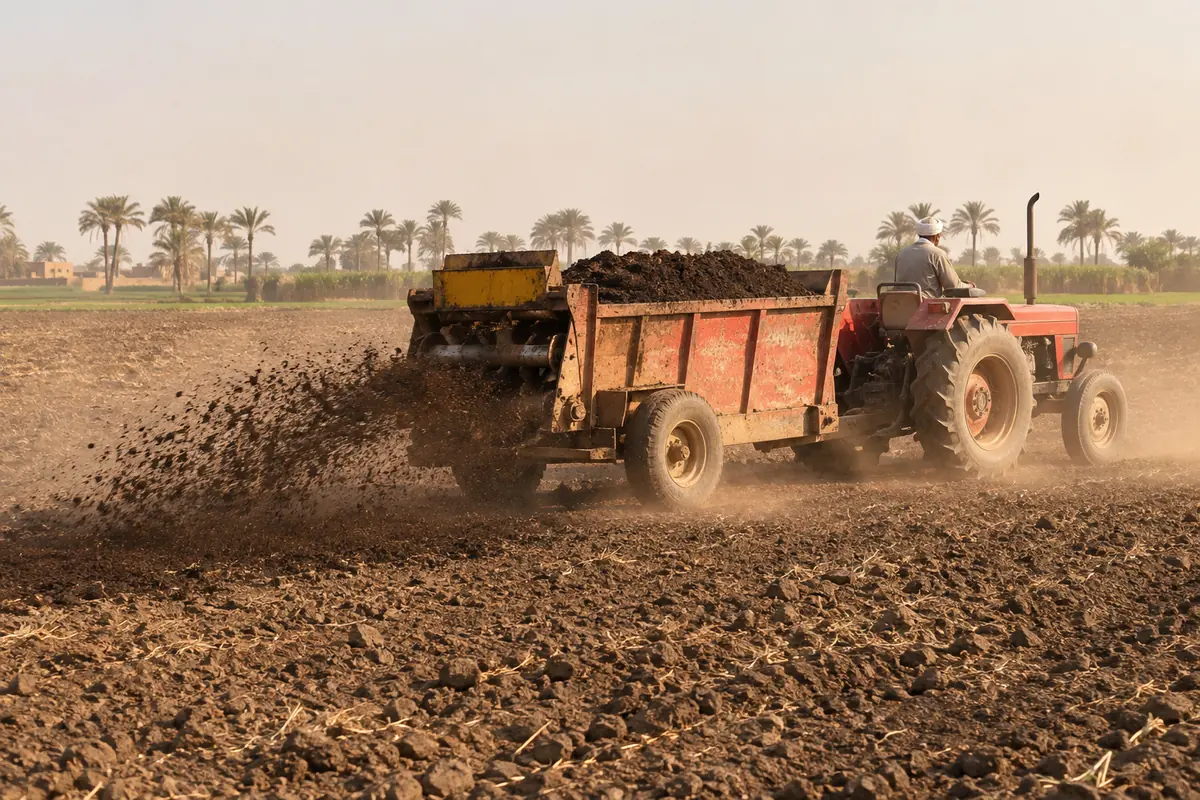
A tractor with a tipping trailer is the normal choice for fields of a feddan or more. The trailer places piles at spacing, and workers or a rotary tool spread them. This is quick but uneven unless you control the spacing.
Manure spreaders
A box spreader with a rear beater or a side-discharge machine spreads continuously while driving. The tractor’s PTO drives the beaters and the floor conveyor. It gives the most even coverage if it is set up correctly. It is also the machine for which the extension services publish calibration guides, covered below.
Loader or bucket
A front loader or bucket loads the trailer, builds and turns heaps and moves pallets. Dust and contamination are easier to control when you load from a firm pad instead of straight from a muddy field.
What to check before the season
- Floors, chains and beaters free of rust and jammed material.
- Gearbox and PTO shaft guarded and greased.
- Tyres inflated for the load.
- Endgate or feed gate moving freely, because it sets the rate.
Part 4: Calibrate instead of guessing
This is the single most valuable habit in the article. A spreader does not know how many tons per feddan you want. You have to measure what it actually throws.
The University of Georgia Extension publication Calibration of Manure Spreaders (C 825) and the Penn State Agronomy Facts 68 both say the only way to know your application rate is to calibrate. They describe three main methods.
Method 1: the tarp (weight-area) method
- Lay a tarp or plastic sheet of known area in the field, flat and secured.
- Drive the spreader over it at your normal speed and setting, with the usual overlap between passes.
- Collect and weigh the manure that landed on the tarp.
- Divide the weight by the area of the tarp.
Penn State gives the conversion to United States units. For readers who work in metric, here is our own arithmetic: one kilogram per square metre equals 4.2 tons per feddan, because a feddan is 4,200 square metres. So if the tarp collects 1.2 kg on one square metre, the rate is about 5 tons per feddan. This is plain arithmetic and not a recommendation, and it assumes the manure on the tarp represents the whole swath.
Method 2: the load-area method
Weigh the spreader empty and full to find the weight of one load. Spread it in a rectangle, measure the width and the length covered, and divide the weight by the area. UGA and Penn State describe this method and advise repeating it once or twice and averaging the results.
Method 3: loads per field
The simplest estimate: count the loads you spread over the field, multiply by the weight per load, and divide by the area. The University of Vermont guide by Bill Jokela, Manure Spreader Calibration, calls this an estimate of the average rate and not a true calibration, because it hides the unevenness within the field.
Spreaders that throw to both sides
UGA notes that spreaders that throw material to both sides need their effective swath width determined, and describes a pattern test using a line of tarps across the path of the machine. The point is uniformity: you want the overlap between passes to even out.
Adjusting the rate
All the sources agree you will likely need to adjust. You can change the conveyor speed or the endgate height, or change your ground speed. After any change, test again and write down the tractor gear, PTO speed and gate setting that gave the rate you want. Next season you will skip the guessing.
What rate should you target?
This article does not set a rate for you, because it depends on the crop, the manure, the soil test and the previous crop. One Arabic source we checked quotes 4 to 8 tons per feddan for farmyard manure, spread by hand or machine and then mixed into the soil. Other crop-specific figures appear in our other articles, each with its source. Treat all of them as ranges quoted by those sources and settle your number with an agronomist.
Part 5: Spreading step by step
- Decide the rate with your agronomist and the soil test.
- Prepare the field. Remove large stones and stalks that could jam a spreader. Mark the strips.
- Check the machine and calibrate on a short stretch.
- Spread evenly, at steady speed, with a constant overlap. Do not stop with the beaters running, or you will dump a pile.
- Mark the passes with poles or by following the tyre marks of the previous run.
- Work it in quickly. The Elaard guide and the Hundzsoil article both put incorporation soon after spreading. Plough or disc the manure into the top soil layer, 15 to 25 cm for field crops according to Hundzsoil. Quick mixing reduces nitrogen loss to the air.
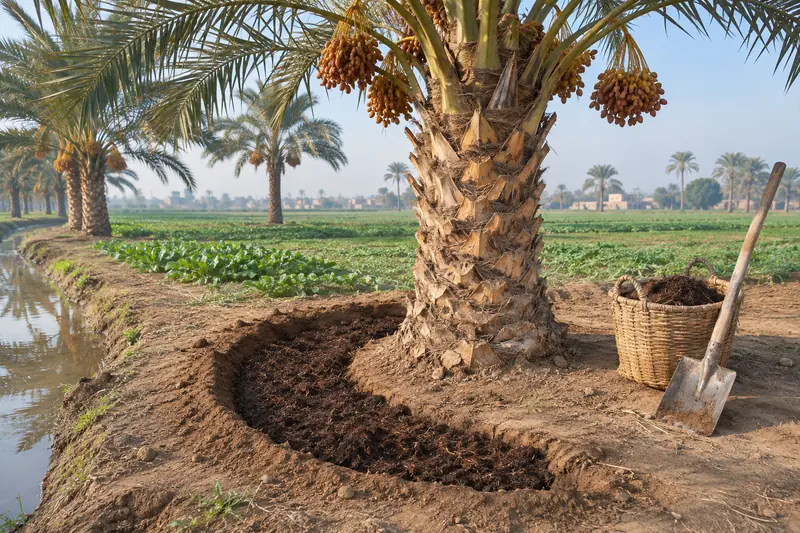
- Do not place fresh manure in the planting hole. The Arabic sources we checked say manure goes in before the last ploughing and not into the hole where the seedling sits, where it can burn roots. For trees, keep fresh manure away from the trunk: Hundzsoil quotes 20 to 30 cm in one section and 30 to 50 cm in the ring method.
- Record what you did: field, date, tons, rate, weather. After two seasons you will see what worked.
Part 6: Safety
Gases in closed storage
If you only handle dry solid manure in open heaps, gas risk is low. If your farm has pits, tanks or a covered slurry store, read this carefully.
The University of Maine Cooperative Extension bulletin Barn and Manure Storage Safety says hydrogen sulfide, carbon dioxide, ammonia and methane are present in every manure storage area, and that hydrogen sulfide released during agitation can kill people and animals within minutes at high concentrations. The Wisconsin Department of Agriculture report on manure gas safety says hydrogen sulfide levels can rise a thousand-fold during agitation and advises keeping ventilation running during removal and for at least 12 hours afterward. Penn State Extension adds that hydrogen sulfide dulls the sense of smell, so the rotten-egg odor is not a reliable warning.
The rules that follow:
- Never enter a pit or spreader tank alone, and never during or just after agitation.
- If someone collapses inside, do not climb in after them without breathing apparatus. Ventilate and call rescue.
- Do not lower electric fans into the pit, because of methane.
- Remove animals and people before agitating, where you can.
Dust, hygiene and pathogens
Fresh manure can carry bacteria such as Salmonella and E. coli, as the Hundzsoil article and the food safety literature both note. Wear gloves and a dust mask when loading dry poultry manure, wash hands before eating, and keep children away from piles. Keep manure away from harvested produce and from irrigation water for vegetables.
Machinery
PTO shafts without guards injure people every year. Never clear a jammed spreader with the engine running. Do not stand beside the beaters.
What to ask your supplier
A good delivery makes storage and spreading easier. Before you order, ask:
- Is the manure aged or fresh, and for how long was it stored?
- How wet is it? You pay by the ton, and water is weight.
- Is it free of large lumps, stones and plastic that would jam a spreader?
- What truck will deliver, and can it reach and tip at the spot you chose?
- When exactly will it arrive, so you can plan the spreading?
- How will the quantity be confirmed, by weight or by load? Our guide on buying by the ton explains why weight is safer than truck count.
We can answer these for our products on WhatsApp. We do not publish lab figures or nutrient percentages on this page, and the sales team confirms prices at order time.
Which products suit which job
Our prices are per ton, confirmed by sales at order time:
- Local livestock manure: 275 EGP per ton
- Raw livestock manure: 375 EGP per ton
- Broiler poultry litter: 900 EGP per ton
- Layer poultry manure: 1,400 EGP per ton
- Al Omariya economy blend: 750 EGP per ton
You can browse the livestock manure and poultry manure families to compare. Poultry manure is stronger and needs more care at the spreading stage, so read does chicken manure burn plants? before you choose it. For the cost comparison with mineral fertilizer, see organic vs chemical fertilizer in 2026.
A simple checklist
| Step | Question |
|---|---|
| Before delivery | Is the pile site dry, firm and away from canals? Do I have a cover? |
| On delivery | Did I check moisture, lumps and smell? Is the load weight confirmed? |
| Before spreading | Is the machine checked and calibrated? Is the rate set from a soil test? |
| While spreading | Even speed, constant overlap, no piles dumped? |
| After spreading | Worked into the soil quickly? Records written? |
| Safety | Pits ventilated, nobody entering alone, guards on? |
Common mistakes
Leaving manure uncovered for weeks. Ammonia and nutrients are lost, and rain washes liquid into the ground.
Spreading by eye. Without calibration you do not know whether you applied half or double what you planned.
Spreading and leaving it on the surface. Quick incorporation reduces nitrogen loss.
Irrigating heavily right after on sandy soil. The Elaard guide warns that nitrogen drains away quickly in sandy land.
Putting fresh manure at the plant. It can burn roots and carry pathogens. Keep it away from trunks and planting holes.
Entering a closed pit. The safety bulletins quoted above warn against it in the strongest terms, including for a rescuer.
Order manure for your fields
Once you know your rate and area, work out the tons and choose the product on the order page. It opens a WhatsApp message with a reference number, and the sales team confirms price, availability and delivery date. We deliver to all Egyptian governorates and have worked with organic fertilizer since 1984. You can also look through the shop, or contact us on WhatsApp and ask which product suits your machinery and your crop.
FAQ
What is the right way to spread manure on a field?
Choose a rate with your agronomist, calibrate the spreader by weighing what it throws on a tarp, spread at steady speed with constant overlap, and work the manure into the soil soon after. The extension sources quoted here all stress measuring the rate instead of guessing.
How long can I store manure before spreading?
The sources we found give no safe number of days. They agree that shorter is better, and that a covered pile on dry, firm ground, away from canals, loses less. Ask for delivery close to the work date.
How do I calibrate a manure spreader?
Lay a tarp of known area, spread over it at normal speed and setting, weigh what lands, and divide by the area. One kilogram per square metre is about 4.2 tons per feddan. Repeat and adjust the gate or speed.
Is it dangerous to work around manure?
Open solid heaps carry a low gas risk, but closed pits and tanks can hold hydrogen sulfide that kills within minutes. Never enter alone, never during agitation, and keep ventilation running.