Organic Manure for Berseem and Sugar Beet: Rates and Timing in Egypt
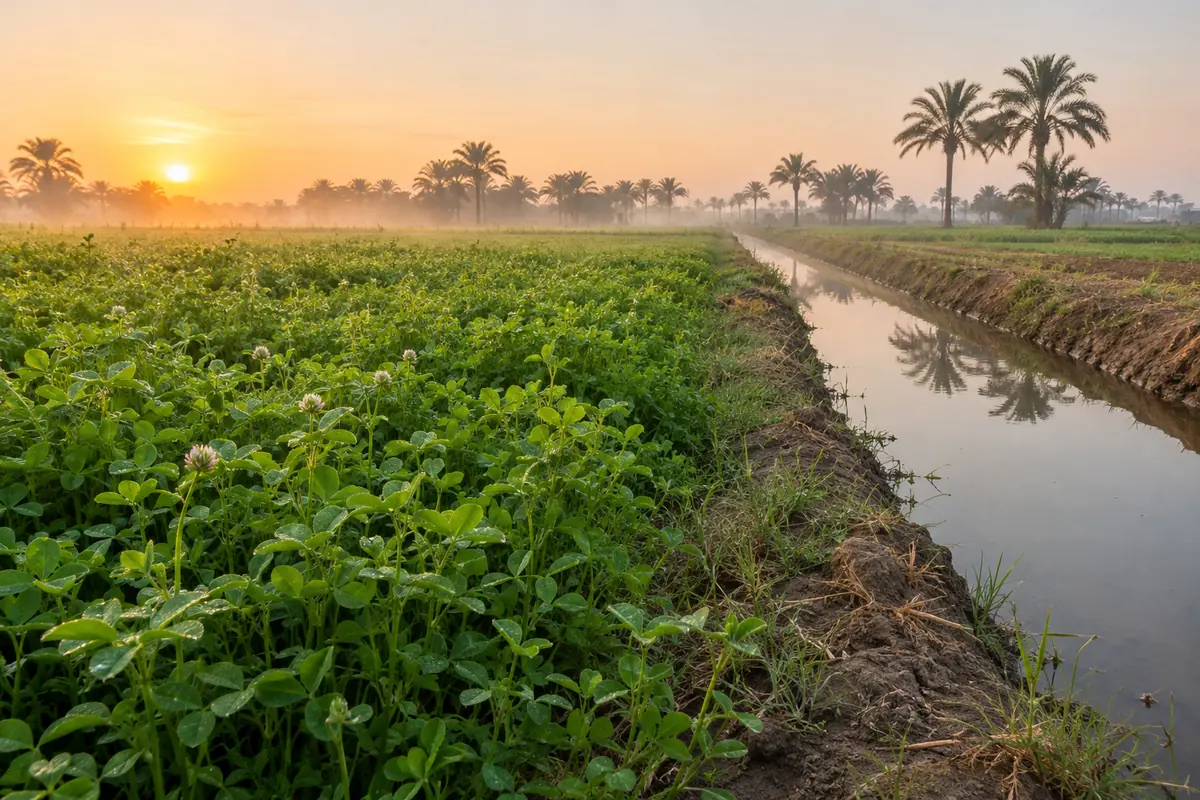
Berseem and sugar beet are both winter crops, and in both the organic manure goes in before planting, during land preparation, not after the crop is up. Egyptian sources quote roughly 20-25 m3 of well-decomposed farmyard manure per feddan for berseem and 15-20 m3 for sugar beet. On sandy and new land it is applied just before planting; on heavy clay several sources say to give it to the previous crop. These are quoted ranges, not our own advice, and a soil test should set the final figure.
Two crops, one question
A Delta or reclaimed-land grower in autumn is usually planning two big winter crops: berseem for the livestock, and sugar beet for the factory. They behave differently. Berseem is a legume that can fix part of its own nitrogen. Sugar beet wants nitrogen in controlled doses and is penalised for too much of it late in the season. Yet both start from the same practical question: how much manure, what kind, when, and is it worth the money?
This article collects what Egyptian extension articles and international sources have published on both crops, separates a published number from practical advice, and shows how to turn a per-feddan range into a per-ton order. Every figure carries its source, because the numbers in this field really do disagree, and we explain why.
Which “berseem” are we talking about?
Two crops share the name in everyday speech, and mixing them up is the main reason the numbers online do not match:
- Egyptian clover (berseem, the “masqawi” type): an annual winter fodder crop, sown in autumn, cut several times and then either ploughed in or followed by a summer crop.
- Alfalfa (called “hijazi berseem” in Egypt): a perennial that is cut through much of the year and stays in the field for years. It is fed harder at planting because it occupies the land longer.
So one article recommends 40-50 m3 and another recommends about half that, and both can be right for their own crop. We keep them apart below.
Manure rates quoted for berseem
| Source | Crop | Quoted rate per feddan |
|---|---|---|
| Royal Green Biotech (a commercial company, program page) | Egyptian clover | 20-25 m3 of treated manure before planting, or before the crop that precedes berseem |
| Al-Ard newspaper, 30 September 2019, quoting engineer Ali Qiyasa, Dakrnis agricultural office | Alfalfa | 40-50 m3 of farmyard manure before planting, mixed with 8 bags of superphosphate and 4 bags of potassium sulphate |
| FAO crop profile, Egyptian clover | Egyptian clover | 20 tonnes per hectare of well-decomposed farmyard manure at field preparation |
| Other Egyptian pages in our search of 14 November 2026 | Alfalfa and reclaimed land | 20-30 m3 after levelling; 20 m3 in newly reclaimed land, mixed in with superphosphate |
How to read the table:
First, the quoted range for Egyptian clover sits around 20-25 m3 per feddan. Second, the FAO figure is per hectare. A feddan is about 4,200 square metres, roughly 0.42 ha, so 20 t/ha works out at about 8 tonnes per feddan. That conversion is our own arithmetic, not a line in the source. Third, a cubic metre is not a fixed weight: it changes with moisture and manure type. That is why we always tell buyers to ask for the actual tonnage of a load, not a “lorry” or a “metre”. Sales can tell you the tonnage behind any quoted volume.
The reclaimed-land advice is consistent with general Egyptian extension guidance: the manure should be old, decomposed and free of weed seed, nematodes and insect larvae, and it should be mixed into the soil during preparation.
Which manure suits these crops?
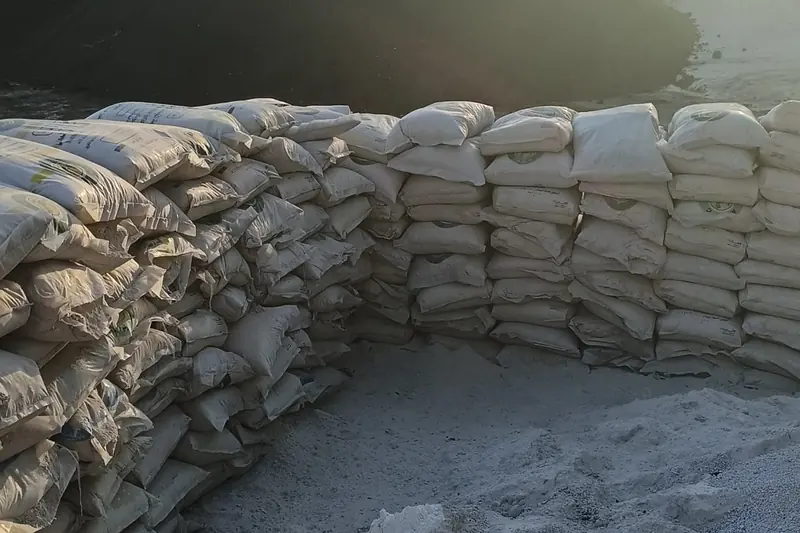
The sources talk about decomposed farmyard manure, meaning aged livestock manure, and about compost. Al Omariya sells these per ton, and sales confirms the final price at order time:
- Local livestock manure: 275 EGP per ton
- Raw livestock manure: 375 EGP per ton
- Plant and animal compost: 650 EGP per ton
- Al Omariya economy blend: 750 EGP per ton
- Mix 70/30: 450 EGP per ton
More options sit under livestock manure and compost and blends. If your field also has a sodium or crusting problem, the agricultural gypsum range is relevant, and we cover it in a separate article, Reclaiming salty soil with gypsum and organic matter.
We do not publish lab figures or nutrient percentages for our products here. For data on a specific product, ask the sales team on WhatsApp before ordering.
Berseem step by step
1) Know your crop and your soil
Is it Egyptian clover or alfalfa, and is the field old clay or new sand? Old Delta clay that has received manure for years needs less than sand that holds almost no organic matter. General sources on sandy soil say exactly that: it is poor in organic matter and loses mineral fertilizer to irrigation water.
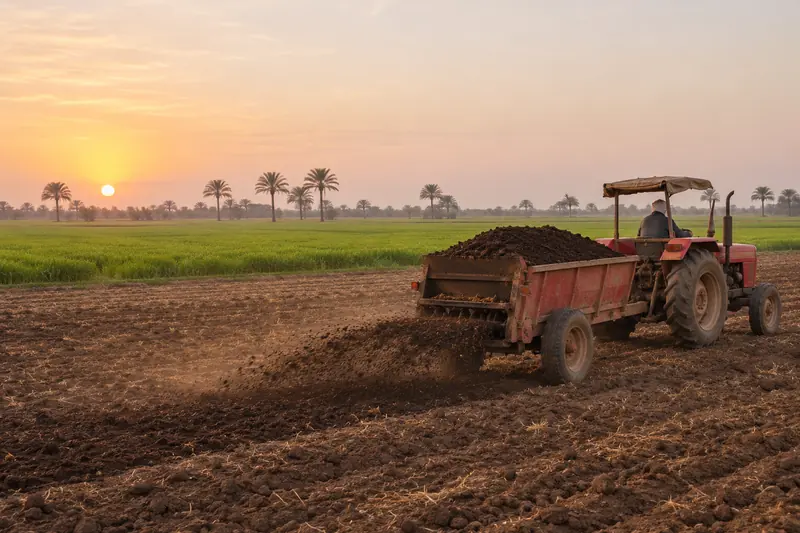
2) Spread during land preparation
The sources apply manure before sowing, during preparation, and then plough it in. Decomposed manure needs moisture and time to blend into the soil, and immature manure placed on emerging seedlings can burn small roots. For the practical side of getting it onto the field see how to store and spread manure.
3) Mix with phosphorus if that is your program
Phosphorus is the element Egyptian berseem programs mention most often. The Al-Ard article on alfalfa gives 8 bags of superphosphate per feddan mixed with the manure and repeated after the eighth cut. The FAO profile reports Egyptian trials that tested 0, 35, 70 and 107 kg P2O5 per hectare, with the best result at 107 kg alongside a seed rate of 57 kg per hectare. By our own conversion that is roughly 45 kg P2O5 per feddan, or around 290 kg of 15.5% superphosphate. It is arithmetic on a trial figure and not a recommendation; your soil test may say something else.
4) Inoculate the seed
Berseem fixes nitrogen only when effective root nodules form. Egyptian guidance is to treat the seed with the matching nodule bacteria, two packets per feddan, especially where berseem has never grown. Manure does not replace inoculation.
5) Check salinity before sowing
Egyptian clover is moderately tolerant of salt. Egyptian agricultural sources describe it as more tolerant than wheat and less tolerant than barley, and name varieties such as Serw 1 and Serw 3 for salty land in the northern Delta. For a salty field the published method is a heavy irrigation, draining, irrigating again and broadcasting the seed into standing water, which dilutes salt around the seed. Very saline land does not suit it at all.
Does manure reduce nitrogen fixation?
An honest question, and we found no firm answer in Egyptian sources. The University of California SAREP berseem page summarises an irrigated California study that estimated fixation at 272-400 kg N per hectare and found that fixation fell sharply when more than 150 kg per hectare of nitrogen per year was available from the soil. That is a different climate, so treat it as a clue. The practical reading is to avoid over-loading a berseem field with very nitrogen-rich material, above all fresh poultry manure. Aged livestock manure is closer to what the Egyptian berseem sources describe. For poultry, read does poultry manure burn plants? first.
On the other side, Egyptian sources say berseem leaves roughly 130 kg of nitrogen per feddan by the end of the season and is a good green-manure legume because its residue breaks down quickly. We pass that figure on as published; it is not a promise for your field.
Sugar beet: timing and rates
Timing first. Dr Mahmoud Otman of the Agricultural Extension Research Institute, writing in Al-Ard on 18 September 2026, lists three sowing windows: early from August to mid-September, mid from mid-September to mid-October, and late from mid-October to the end of November, with October generally preferred. The same article gives a seed rate of 4-6 kg per feddan for multigerm varieties and 2-3 kg for monogerm or mechanically segmented seed.
On manure the same source says 15-20 m3 of well-decomposed manure before planting, during land preparation, in sandy and new soils, and in clay soils to give it to the previous crop. A second Al-Ard article, dated 18 August 2026 and quoting engineer Metwally Sweilam of the Agricultural Reclamation Directorate in Kafr El-Sheikh, also gives 15-20 m3 and calls it optional, aimed at soils that need more organic matter. That is for first-season beet on clay soil under flood irrigation.
Note what both say: optional in clay, or for the previous crop. This matters. Not every beet field needs manure every year. A grower who fed the previous crop well may not need to add any before beet, and the sources themselves say so.
The mineral program, so you see where manure fits
Engineer Sweilam’s program, for first-season clay soil under flood irrigation, is given by him as indicative and to be adjusted to a soil analysis:
- Before planting: 200 kg of single superphosphate (15.5%) with land preparation, plus the optional manure.
- First dose after thinning, 25-30 days after planting: 50 kg urea or 50 kg ammonium nitrate, with 50 kg potassium sulphate, placed beside the plants and followed by a light irrigation without flooding. This matters most on land planted after rice.
- Second dose, 25-30 days later: 100 kg urea or 135 kg ammonium nitrate.
- Third dose, another 25-30 days on and before 90 days: the same as the second.
- Micronutrient sprays with boron, zinc and manganese at 50-55 and again at 70-75 days.
The key warning: nitrogen stops at 90 days, because late nitrogen can lower sugar content. This is why manure belongs before planting and not late in the crop. A fast-releasing, nitrogen-rich material breaking down late can work against the factory’s sugar target. Aged livestock manure and mature compost suit this better than fresh material.
What trials say about beet and organic matter
These are small Egyptian trials on specific soils. We quote them as examples, not rules:
- A study on saline sandy soil at Wadi El-Natroon (Egyptian Journal of Agricultural Sciences, volume 62 issue 4) recommended variety KWS1436 with 4 tons of compost and 80 kg N per feddan, and reported that organic fertilizer increased root yield, sugar yield, sucrose content and purity.
- A study on newly reclaimed sandy soils (International Journal of Agriculture, Forestry and Life Sciences) reported its highest yields with 9 tons of plant compost or chicken manure plus 40 kg N per feddan, with chicken manure ahead of plant compost.
- A Desert Research Center study at El-Tur in South Sinai recommended the variety Salama with organic fertilizer at 10 tons per feddan.
These rates differ from 15-20 m3 because the soils, materials and nitrogen programs differ. The general direction, organic with mineral on new land, is what you can take from them. Do not read them as a promise of higher yield or sugar in your field or at your factory.
Clay versus sandy soil
The difference between these two soils is the biggest reason the numbers differ, so it deserves its own section.
Old Delta clay. It holds water and nutrients and often has a long manure history. That is why the beet sources call manure optional there and say to give it to the previous crop. The clay risk is drainage and aeration rather than a shortage of organic matter: heavy irrigation after rice, or on compacted land, can suffocate beet roots. Engineer Sweilam warns against flooding and asks for irrigation on the ridges. Manure helps the structure, but it does not replace drainage.
Sandy and reclaimed land. General sources describe sandy soil as poor in organic matter and quick to lose mineral fertilizer, and some raise manure rates by 20-50% in new land compared with old land. Here it helps to add manure just before sowing and to split the mineral nitrogen into doses, as in the beet program above.
Calcareous and salty land. A paper in an Egyptian academic journal indexed on the Egyptian Knowledge Bank found that growing Egyptian clover improved calcareous soil properties under saline irrigation water compared with Nile water, but it also recorded a large fall in iron, manganese, zinc and copper in the topsoil after the crop. For a calcareous field, watch the micronutrients and do not assume manure alone covers them.
Worked cost example per feddan
These are sums on quoted ranges and our per-ton prices, for the material only and without transport or labour. Sales confirms the final price at order time.
- Egyptian clover at the converted FAO rate (about 8 tons per feddan): with local livestock manure at 275 EGP per ton that is about 2,200 EGP; with raw livestock manure at 375 EGP per ton about 3,000 EGP.
- Sugar beet at the 4 tons of compost used in the Wadi El-Natroon trial: plant and animal compost at 650 EGP per ton comes to about 2,600 EGP per feddan.
- A 10-feddan berseem block at the same rate: 80 tons, and at 275 EGP per ton about 22,000 EGP.
The key point is that 20 m3 is not a fixed number of tons, so ask your supplier for the real weight of the load. If you are weighing this against chemical fertilizer after this year’s price rises, organic or chemical fertilizer? sets the published figures side by side. Delivery distance, quantity and the product chosen all affect the final price.
When to order: a short calendar
- September and October: autumn sowing of alfalfa according to the published article, and the mid beet window. Order manure at least two weeks before ploughing so the land is not kept waiting.
- October and November: international sources give September to November for Egyptian clover, FAO trials included sowing in November and December, and the late beet window runs to the end of November. If you are in this window now, time is short: collect your quantities early and ask about delivery dates.
- After spreading: plough, level and irrigate as usual, without leaving manure lying in the sun between spreading and ploughing.
- After the first cut of berseem: check with your agronomist whether more phosphorus or micronutrients are needed, based on what the crop shows.
Where our knowledge stops
We should be plain about the limits. In our search of 14 November 2026 we did not find a peer-reviewed Egyptian comparison of berseem fed farmyard manure against berseem without it in the Delta. Most of the figures here are advisory ranges from agricultural news articles or companies, or results from trials on particular soils. Some are old: the alfalfa article dates from 2019. So treat every number as a range for orientation, and let a soil analysis and your agronomist make the final call. We do not promise a yield increase or a higher sugar percentage, because those depend on variety, irrigation, sowing date and the state of the land before any manure.
Common mistakes
Using fresh, immature manure. It can scorch seedlings and bring in weed seed that costs you later in control. Egyptian guidance asks for old, decomposed manure free of weed seed, nematodes and insect larvae.
Mixing up alfalfa and Egyptian clover rates. Take the 40-50 m3 figure for a field you will sow with Egyptian clover and you pay for roughly double what the sources suggest.
Skipping seed inoculation. Manure does not replace the nodule bacteria, particularly on land new to berseem.
Adding nitrogen late in sugar beet. The sources stop it at 90 days because late nitrogen can lower sugar.
Feeding salty land without leaching. Manure itself can carry salts, as general sources warn, especially near the coast. Test soil and water salinity before increasing the rate.
Buying by the lorry. Two lorries that look alike can carry different weights. Order by the ton.
What to ask your supplier
- How mature is it? Ask how long it was composted. Mature manure is dark, crumbly and earthy-smelling, not sharp.
- What is the moisture? Wet manure means you pay for water by the ton.
- Can I see the pile or a sample? Ask for a photo or a visit before loading.
- What is the real weight of the load? Do not accept a “lorry” or a “metre” with no weight.
- Is there weed seed in it? The sources warn about it, and it costs you in control later.
- How long will delivery to my governorate take? It matters in planting season when time is tight.
After delivery, keep the pile covered and off waste ground, and our sales team can answer questions on the data available for a specific product.
Summary before you order
- Decide the crop: Egyptian clover, alfalfa or sugar beet.
- Decide the soil: old clay or new sand, and test the soil and the water.
- Pick the quantity from the quoted ranges, together with your agronomist.
- Convert cubic metres to tons with your supplier before pricing the order.
- Add the manure during preparation, not after emergence.
- Inoculate berseem seed, and stop nitrogen on beet at 90 days.
Order manure for berseem and sugar beet
Once you know the quantity, choose the product by the ton and your governorate on the order page. It opens a WhatsApp message with a reference number, and sales confirms price, availability and delivery date. We deliver to every governorate in Egypt and have worked in organic fertilizer since 1984. To browse first, open the shop, or contact us on WhatsApp and ask which product suits your land and season.
FAQ
How many cubic metres of manure does a feddan of berseem need?
Quoted Egyptian ranges for Egyptian clover are around 20-25 m3 per feddan before sowing, and 40-50 m3 for alfalfa in the Al-Ard article. The gap is because they are different crops. Fix the figure with a soil test and with the supplier’s real weight per metre.
Does sugar beet need manure every year?
Not necessarily. The sources call it optional on clay soil and say to give it to the previous crop there, while on sandy and new soils they say to add 15-20 m3 before planting.
When should nitrogen stop on sugar beet?
The published programs finish nitrogen before the crop reaches 90 days, because late nitrogen can lower the sugar content.
Can I put manure on berseem after sowing?
The published practice is to apply it before sowing, during land preparation. Immature manure on seedlings can burn them, so ask your agronomist before adding any after a cut.