Organic Fertilizer for Potatoes in Egypt: Before Planting and After
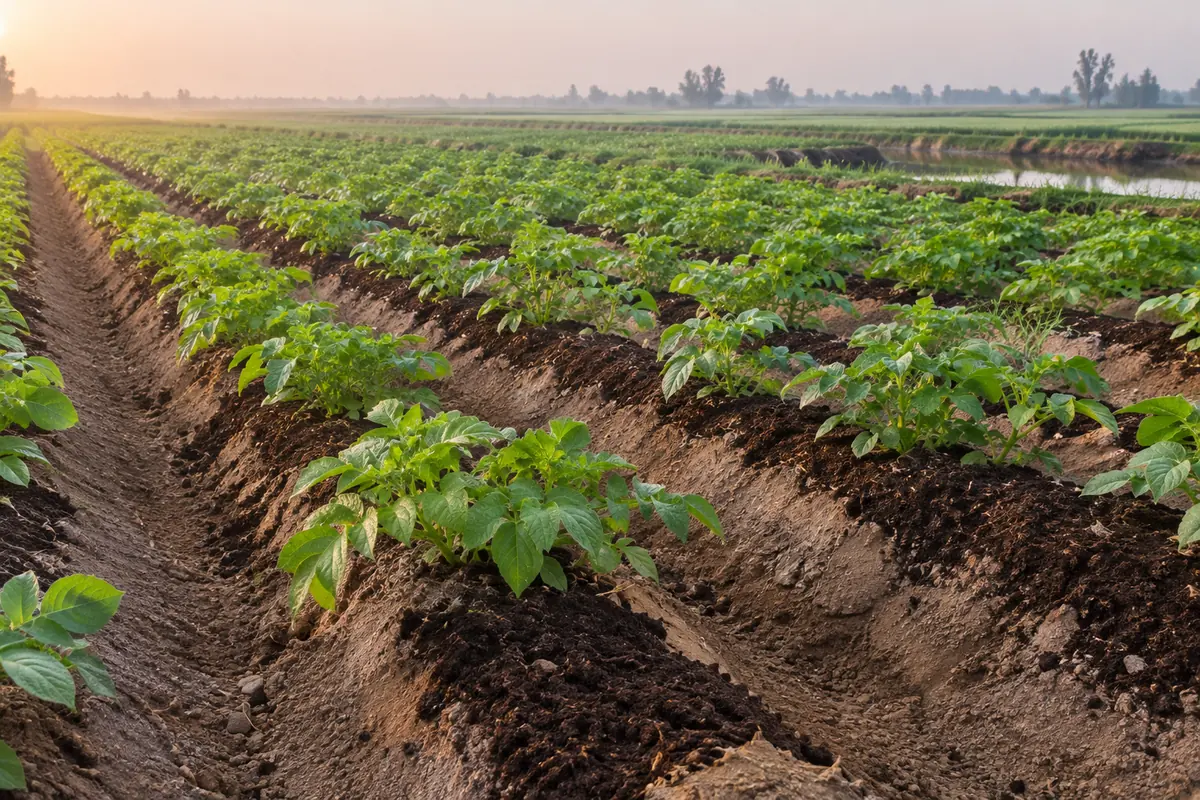
Most Egyptian guidance puts organic manure on potatoes before planting, during land preparation and before the final plowing, using old, well-decomposed material. The figure that keeps coming up is about 20 cubic meters per feddan, rising to 30 on heavy clay or new sandy land. Those are ranges quoted from published sources, not our recommendation, and they should be adjusted by a soil test and your agronomist.
Why potatoes respond to organic matter
Potatoes are shallow-rooted, and the tubers form inside the soil itself. Two things follow. Loose soil that holds even moisture lets tubers swell smoothly, and ground that swings between dry and soaked produces rough, knobby tubers. The University of California’s IPM guide says exactly that: alternating wet and dry soil can leave tubers “rough and knobby”, and potatoes want light, frequent watering.
Manure or compost does not replace a fertilizer program. It works on a different side of the problem. It raises organic matter, helps sand hold water, and opens up heavy clay. On newly reclaimed land, where mineral fertilizer washes out with irrigation water quickly, it is usually the first step before anyone designs a drip program.
A rule we apply in every article: figures below are quoted from named, published sources and attributed. Where a source gives no number for something, we say so rather than inventing one.
Where the numbers come from
We reviewed three main sources on 13 November 2026:
- The drip fertilization program published by Al-Ard (elaard.com) on 30 September 2026, credited to Eng. Ahmed Manna, head of extension at the Beni Suef Agricultural Directorate.
- The potato page on Zatonaz Zeraeya, an Egyptian farming site with land-preparation steps and manure rates by soil type, plus crop-rotation advice.
- The PotatoPro guide to organic fertilizers in potatoes, an international source that gives rates per hectare and explains decomposition time.
We also drew on the University of California IPM potato guide for irrigation, and on the USDA National Organic Program rule on the interval between raw manure and harvest. Where the sources disagree, we say so instead of picking one number and hiding the gap.
Which season are you planting?
Egypt has three potato seasons, but the names and dates change from one source to the next, which is a well-known source of confusion. In the sources we read:
| Season | Quoted timing | Note |
|---|---|---|
| Summer | mid-January to mid-February; some growers start in December | relies heavily on imported seed |
| Nili (Nile) | August to September; other sources run it to mid-October | mostly for the local market |
| Winter | September to October in newer sources; late October to mid-November in older bulletins | sometimes called “Mahayra” |
What matters for you is counting backward. Manure needs time to break down and spread through the soil. PotatoPro advises mixing decomposed manure into the soil two to four weeks before planting. If you plant in September, prepare in August. If you plant in January, prepare in December. As we write in mid-November, growers planning the January summer crop have time to order and prepare, and those planning the next Nili crop have months, though booking early avoids the seasonal rush.
How much organic manure do potatoes need?
Here are the figures exactly as the sources give them:
| Source | Land type | Quoted figure |
|---|---|---|
| Beni Suef extension (Al-Ard, 30 Sep 2026) | not specified | 20 m³ per feddan before planting, during land preparation |
| Zatonaz Zeraeya | old Nile Valley land | 20 m³ of old farmyard manure, raised to 30 m³ on heavy clay |
| Zatonaz Zeraeya | sandy soils | 30 m³ of old manure from a reliable, clean source |
| Zatonaz Zeraeya | alternative | municipal waste compost, about 6 tons per feddan, with mineral fertilizer cut by 25% |
| PotatoPro | general, per hectare | 20 to 50 tons per hectare of well-decomposed compost or farmyard manure, incorporated before planting |
Three points prevent misreading. First, the first three figures are in cubic meters and the last is in tons per hectare. A feddan is about 4,200 square meters, less than half a hectare, so do not convert between the two by eye. Second, cubic meters do not convert to weight reliably: a cubic meter of manure weighs different amounts depending on moisture and what went into it. Third, the sources list 30 for both sandy and heavy clay land. That is not a contradiction. Sand needs organic matter to hold water, and heavy clay needs it to loosen up.
Cubic meters versus tons
Because Egyptian sources speak in cubic meters, ask your supplier what a cubic meter of the specific material weighs, and then work in tons. Al Omariya sells by the ton. We do not give you a fixed conversion, because it moves between dry and wet material and between poultry litter, livestock manure and compost.
Which products we offer
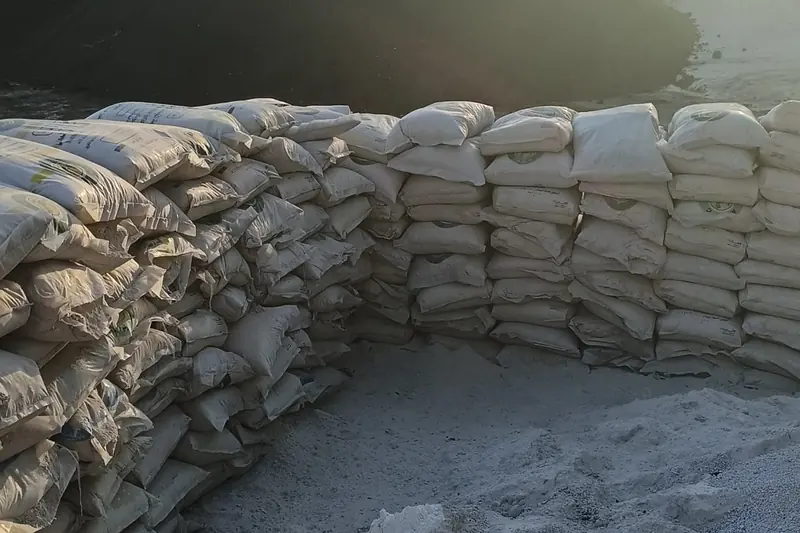
The sources describe old, decomposed farmyard manure or compost. At Al Omariya we sell the following by the ton, and sales confirms prices at order time:
- Local livestock manure: 275 EGP per ton
- Raw livestock manure: 375 EGP per ton
- Plant and animal compost: 650 EGP per ton
- Al Omariya economy blend: 750 EGP per ton
- Mix 70/30: 450 EGP per ton
Other items are listed under livestock manure and compost and blends. We do not publish lab figures or nutrient percentages for our products on this page. If you need data on a specific product, ask the sales team. Which one suits your field depends on soil type and condition, your budget and your planting date.
Land preparation, step by step
We summarize what the sources describe, in a practical order.
1) First plowing and clearing
Zatonaz Zeraeya recommends plowing two or three times, with leveling in between. This breaks clods and exposes soil insects.
2) Spread the decomposed manure
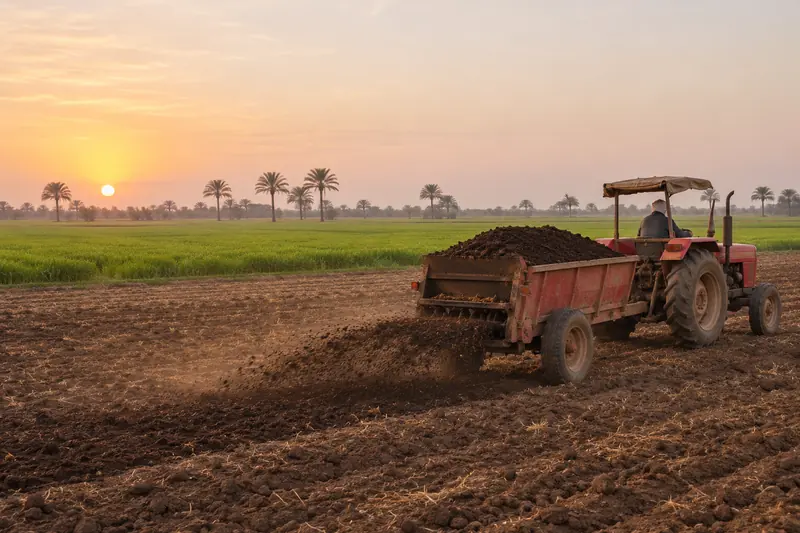
Organic manure and superphosphate go on before the final plowing so they mix into the soil. The Beni Suef program places manure at the same stage, during land preparation. If you spread with a tractor, keep the material dry and uniform before spreading. Our article on how to store and spread manure covers equipment and timing.
3) Final plowing and leveling
The sources warn against low spots in the field, because standing water in a hollow rots tubers. Good leveling is part of fertilizing, not a separate job.
4) Marking and planting
Zatonaz Zeraeya describes seed pieces placed at the bottom of the furrow 20 to 30 cm apart and 10 to 15 cm deep, sprouts up, then covered quickly so the soil does not dry out.
What goes in alongside the manure
The Beni Suef drip program published by Al-Ard lists, next to 20 m³ of organic manure per feddan, these mineral inputs before planting: 400 kg superphosphate, 25 kg magnesium sulfate, 50 kg potassium sulfate, 100 kg ammonium sulfate and 100 kg agricultural sulfur. It then runs a program from about day 10 after planting to about day 90, and stops soil fertilization from day 91 to day 120 while the vines are cleared. It is a drip program and does not apply word for word to surface irrigation.
We do not hand out mineral programs. That is your agronomist’s job. But two points from the published material matter. First, count the organic input as part of the program, not on top of it: Zatonaz Zeraeya says municipal compost allows mineral fertilizer to be cut by about 25%. Second, PotatoPro says only 30 to 70% of the nutrients in organic material become available to the plant in the first season, because release depends on temperature, moisture and microbial activity. So do not treat manure as a ready-made mineral fertilizer.
Scab and manure: what we know and what we do not
Growers ask whether manure causes scab. Here is what the sources show:
- We found no published Egyptian source that links a specific manure to common scab. We do not attribute that claim to anyone.
- Zatonaz Zeraeya lists the soil diseases that hit potatoes, including brown rot, soft rot and common scab, and makes a rotation of at least three years the main protection.
- Every source that gives manure rates asks for old, decomposed material from a reliable, clean source. That tells you the direction of the risk: fresh or half-decomposed manure is the problem, not organic fertilizer as such.
In practice: never apply manure that has not finished decomposing, do not repeat potatoes on the same plot year after year, and ask the supplier how they know the manure is decomposed. If a plot already had scab, do not rely on manure choices alone. Review the rotation and seed health and talk to your local extension office.
Poultry manure on potatoes
Some programs add poultry manure alongside farmyard manure because it is richer in nitrogen. We cannot give you a documented rate: the three sources we relied on give no separate rate for poultry manure on potatoes, so we will not invent one.
What we can say plainly is that poultry manure should never go on fresh or in excess. We wrote a full piece on that: Does chicken manure burn plants?.
There is also a rule for growers who sell to buyers that require organic certification. The USDA National Organic Program requires at least 120 days between incorporating raw manure and harvesting a crop whose edible part touches the soil, which includes potatoes. That applies to anyone working under that system and is not a requirement on every grower. If certification is your goal, read Organic farming certification in Egypt first.
Salinity: do not ignore your irrigation water
PotatoPro warns that some organic fertilizers can be high in salts and cause salt burn on roots, and it recommends deep incorporation to reduce the risk. This matters on the coast and wherever the irrigation water is salty. If your land is already saline, manure alone does not solve the problem, and you may need to treat the salinity first with gypsum and leaching. See Reclaiming salty soil.
Salt levels vary by source, and we do not quote a figure for ours, so ask for a sample and, where possible, a salinity test.
A rough timeline for a crop planted about two months from now
| Before planting | Action |
|---|---|
| 8 to 6 weeks | Soil test, agree the quantity with your agronomist, order and reserve |
| 6 to 4 weeks | Receive and inspect the manure (color, smell, moisture) and store it away from rain |
| 4 to 2 weeks | First plowing, spread manure and superphosphate, mix them in |
| Last week | Final plowing, leveling, marking the furrows |
| Planting day | Plant healthy seed, then irrigate according to soil type |
The intervals are approximate and built on PotatoPro’s two-to-four-week rule, which fits what Egyptian sources say about adding manure during land preparation. They are not an official extension schedule.
Irrigation after fertilizing
The University of California guide stresses light, frequent watering and warns that uneven moisture produces rough tubers. Egyptian sources add that tuber formation and bulking, from about seven weeks after planting, is the most water-sensitive stage, and quote about 10 to 12 irrigations for the summer crop and 6 to 8 for Nili and winter crops. These vary by region and soil, so fix them with local extension.
Organic matter helps indirectly: soil rich in it holds water longer, so the swings between dry and wet are smaller. It does not replace a regular irrigation schedule.
Common mistakes with organic fertilizer on potatoes
1) Using manure that has not decomposed. This is the most damaging mistake. Undecomposed manure can heat up in the soil, and Egyptian guidance for other crops requires manure free of weed seeds, insect larvae and pathogens. PotatoPro suggests letting manure decompose for three to four months before use.
2) Over-applying. Zatonaz Zeraeya notes that heavy organic fertilization increases cutworm problems, and that some pests are common in organically fertilized sandy soils. More is not better.
3) Spreading after the last plowing. The manure sits on the surface, dries out, loses value and is hard to distribute evenly. Mix it in before the final plowing.
4) Buying a truck load with no weight. Trucks differ in capacity. Order by the ton and ask how the weight is measured.
5) Leaving low spots unleveled. Standing water means rot, however good the manure.
6) Repeating potatoes on the same land. A rotation of at least three years is the main protection against soil diseases in the source we used. Manure does not replace it.
7) Covering stored tubers with haulms. Zatonaz Zeraeya recommends clean, dry rice straw, not potato vines, to avoid spreading disease and insects. This is not about manure, but it helps anyone storing a crop.
What to ask your supplier
Organic manure quality varies by supplier. Keep this list in your pocket:
- Which animal? Livestock, poultry or a mix, and what share of each.
- How long has it been composting? Decomposed manure is dark, crumbly and smells earthy, not sharp.
- Has it been cleared of weed seeds and larvae? The Egyptian guidance for other crops makes this a condition, and it is sensible for potatoes.
- What is the moisture? Soaking-wet manure means you pay for water at the price of manure.
- Can I see a sample or a photo of the pile before loading? A supplier who hesitates is giving you a signal.
- How do you measure quantity? Weighed tons, truck loads or cubic meters?
- What is in the price? Transport, loading and number of governorates all change it.
- Do you give an invoice and a contact for follow-up? This helps with accounts and with the next season.
We do not say other suppliers are worse. We encourage you to ask these questions of every supplier, us included. Our sales team answers questions about our own products and can send photos of current stock on WhatsApp.
A budget example
This is simple arithmetic on published prices, not a recommendation of a quantity. Suppose your agronomist decides a plot needs 10 tons of manure:
- Local livestock manure at 275 EGP per ton: 2,750 EGP for the material.
- Raw livestock manure at 375 EGP per ton: 3,750 EGP.
- Plant and animal compost at 650 EGP per ton: 6,500 EGP.
These cover material only, without transport, loading or spreading, and final prices are confirmed by sales at order time. The useful comparison is not between two ton prices but between what each option saves in your mineral program and what it costs in preparation and transport. For a wider comparison with mineral fertilizer, see Organic vs chemical fertilizer in 2026.
Potatoes, tomatoes and the next crop
Many potato growers plant tomatoes or peppers on the same land before or after potatoes. Take care here: tomatoes and potatoes belong to the same plant family and share some diseases. Manure does not fix that, and rotation does. If you are planning what comes next, our guide on organic feeding for tomatoes and peppers may help, and for winter crops see berseem and sugar beet.
The short version
- Decide the season and planting date, then count backward.
- Run a soil test and agree the quantity with your agronomist. Published figures revolve around 20 to 30 m³ per feddan.
- Buy decomposed manure by the ton, inspect it and take a sample.
- Spread it before the final plowing and mix it in, two to four weeks before planting.
- Count it inside the mineral program, not on top of it.
- Pair it with a rotation and regular irrigation.
Order manure for your potatoes
When you know the quantity, choose the product, tons and governorate on the order page. That opens a WhatsApp message with a reference number, and the sales team confirms price, availability and delivery date. We deliver to all Egyptian governorates and have worked with organic fertilizer since 1984. You can also browse the shop first, or contact us on WhatsApp and ask which product suits your land and season.
FAQ
How many cubic meters of manure do potatoes need per feddan?
Published sources quote about 20 m³ per feddan before planting, rising to 30 m³ on heavy clay or new sandy land. These are quoted ranges, so adjust them by soil test.
When should I apply organic manure to potatoes?
During land preparation, before the final plowing, two to four weeks before planting according to PotatoPro. It should be decomposed, not fresh.
Does organic manure replace mineral fertilizer for potatoes?
No. The sources say only 30 to 70% of its nutrients become available in the first season, and the Beni Suef program combines manure with a full mineral program. Count it inside the program and use it to improve the soil.
Can I use poultry manure on potatoes?
We found no documented rate for poultry manure on potatoes, and we do not invent one. If you use it, it must be decomposed and in an amount set by your agronomist. Read the burn article first.